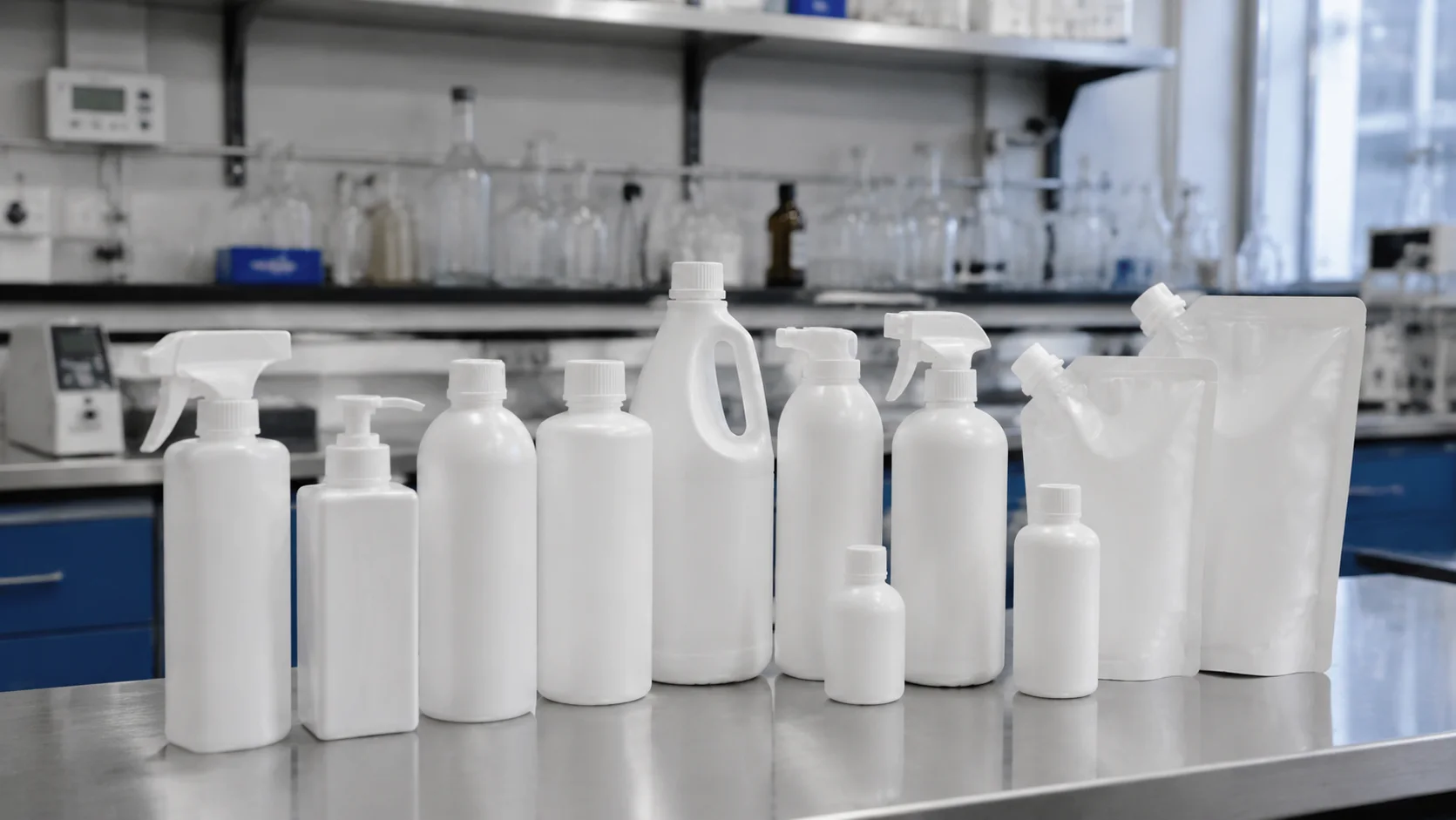
Packaging is usually the second largest cost in a household cleaning product after the formula itself. It is also the part of a quotation that buyers compare most closely — and the part most often compared incorrectly.
Two suppliers can quote the same 500 ml floor cleaner at noticeably different prices and both be telling the truth. The difference is rarely the bottle. It is what the bottle costs to fill, label, pack, palletise and ship.
This guide explains how household cleaning product packaging cost is actually built, where the hidden costs sit, and why design decisions made in the first week of a project end up setting the unit price for years.
It also explains how packaging design and moulding work at BIKI Home Care — both run in-house — and why design is included in OEM and ODM projects rather than billed as a separate service.
—
Where Household Cleaning Product Packaging Cost Actually Comes From
A packaging quotation for a liquid cleaning product is normally made of six parts. Most buyers only look at the first one.
- Primary pack — bottle, jar, can or pouch
- Closure — cap, trigger, pump or sprayer
- Label and decoration — printed label, shrink sleeve, silk screen or in-mould label
- Transport packaging — carton, divider, polybag and pallet wrap
- Tooling and setup — mould, printing plate, screen and colour matching
- Freight weight and volume — how much air and water you are shipping
The first three are visible on a sample. The last three are where quotations diverge.
A bottle that costs less per unit but weighs more, stacks badly or needs a custom mould can cost more per delivered case than a slightly more expensive stock bottle. The bottle price is a component. The delivered case price is the number that reaches your margin.
The useful rule: compare packaging cost per landed case, not per bottle.
—
Why the Cheapest Bottle Is Rarely the Cheapest Order
There are five reasons a low bottle price turns into a high order cost. None of them appear on the bottle price list.
Tooling is charged once but amortised over the whole order. A custom mould for a 500 ml bottle is a significant one-time investment. Spread across 20,000 units it is a small addition to the unit price. Spread across 3,000 units it can change the economics of the product entirely.
Minimum order quantities move with the mould. Custom shapes normally carry higher MOQs than stock bottles, because the moulding line needs a longer run to be economical. Buying more stock than you can sell in a season is a cost, even at a lower unit price.
Volume and weight decide freight. A heavier bottle, a thicker carton or an inefficient pallet pattern all raise the freight cost per unit. On ocean freight this can quietly exceed the saving on the bottle itself. In the United States, the same weight figures now decide a packaging EPR fee as well, which is a separate reason to record them component by component — see the weight data your supplier has to give you.
Cheap closures fail at the filling line. A trigger that leaks or a cap that does not torque correctly produces rejects, rework and returns. That cost appears in the claim rate, not on the invoice.
Damage is a packaging cost too. Leaking bottles damage the cartons around them, and a wet pallet is often rejected at the destination. Buyers who have opened a container of leaking floor cleaner stop comparing bottle prices.
The cheapest order is not the one with the lowest bottle price. It is the one where bottle, closure, label, carton, pallet and freight were designed together from the start.
—
Four Packaging Routes and What Each One Costs
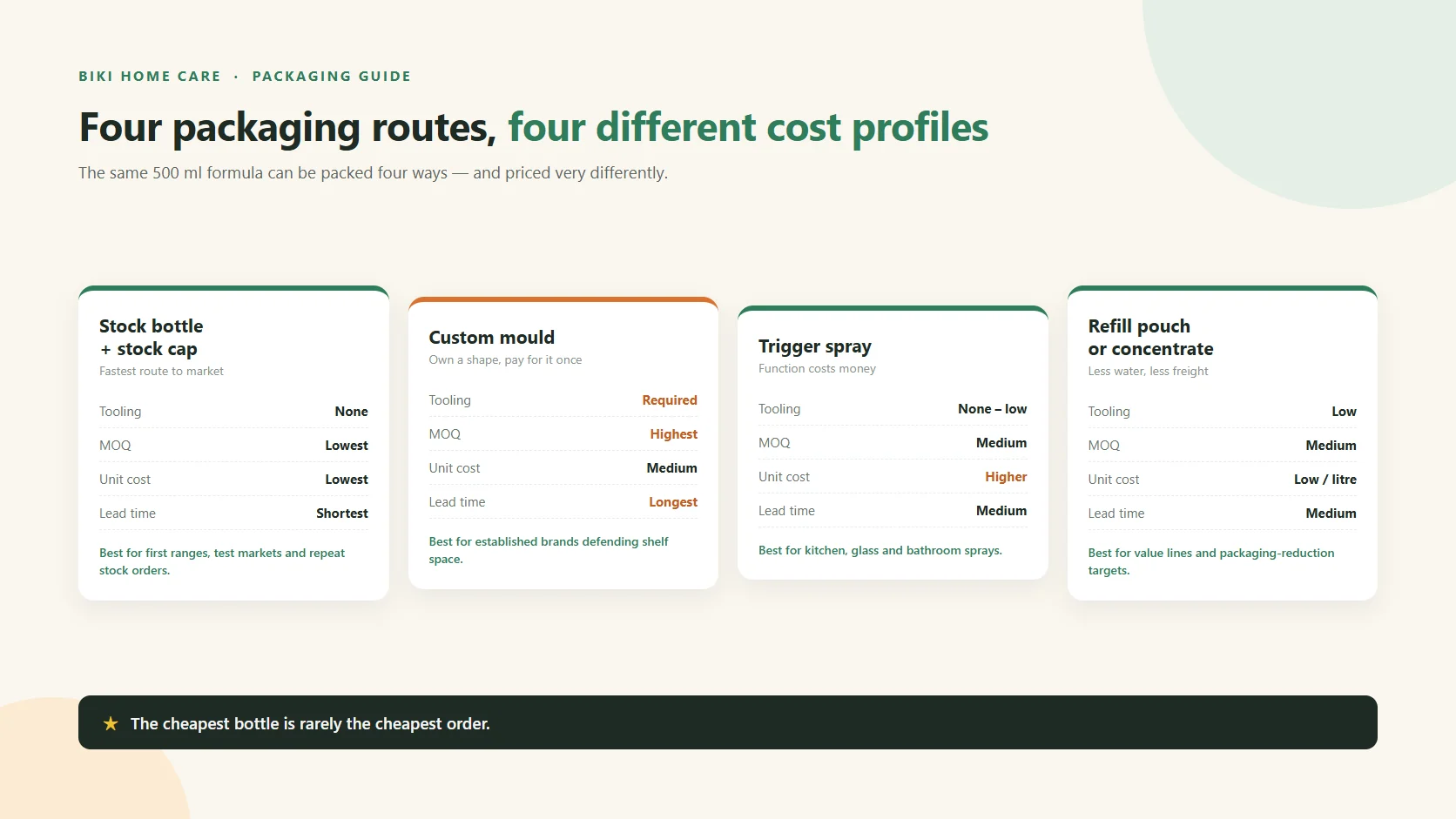
Most household cleaning products can be packed four different ways. Each route has a different cost profile, and the right one depends on where the product sits in its life cycle.
Stock bottle with stock cap. No tooling, lowest MOQ, shortest lead time. This is the fastest route to market and the right choice for a first range, a test market or a repeat stock order.
Custom mould. You pay for tooling once and own the shape. Unit cost can be competitive at volume, but MOQ and lead time are the highest of the four routes. This suits established brands defending shelf space.
Trigger spray. The function costs money. A trigger or sprayer adds a mechanical assembly to the pack, which raises unit cost and adds a component that has to be tested. For kitchen, glass and bathroom sprays it is usually worth it.
Refill pouch or concentrate. Less water, less plastic, less freight. Unit cost per litre is often the lowest of the four routes, and it is the route most compatible with packaging-reduction targets.
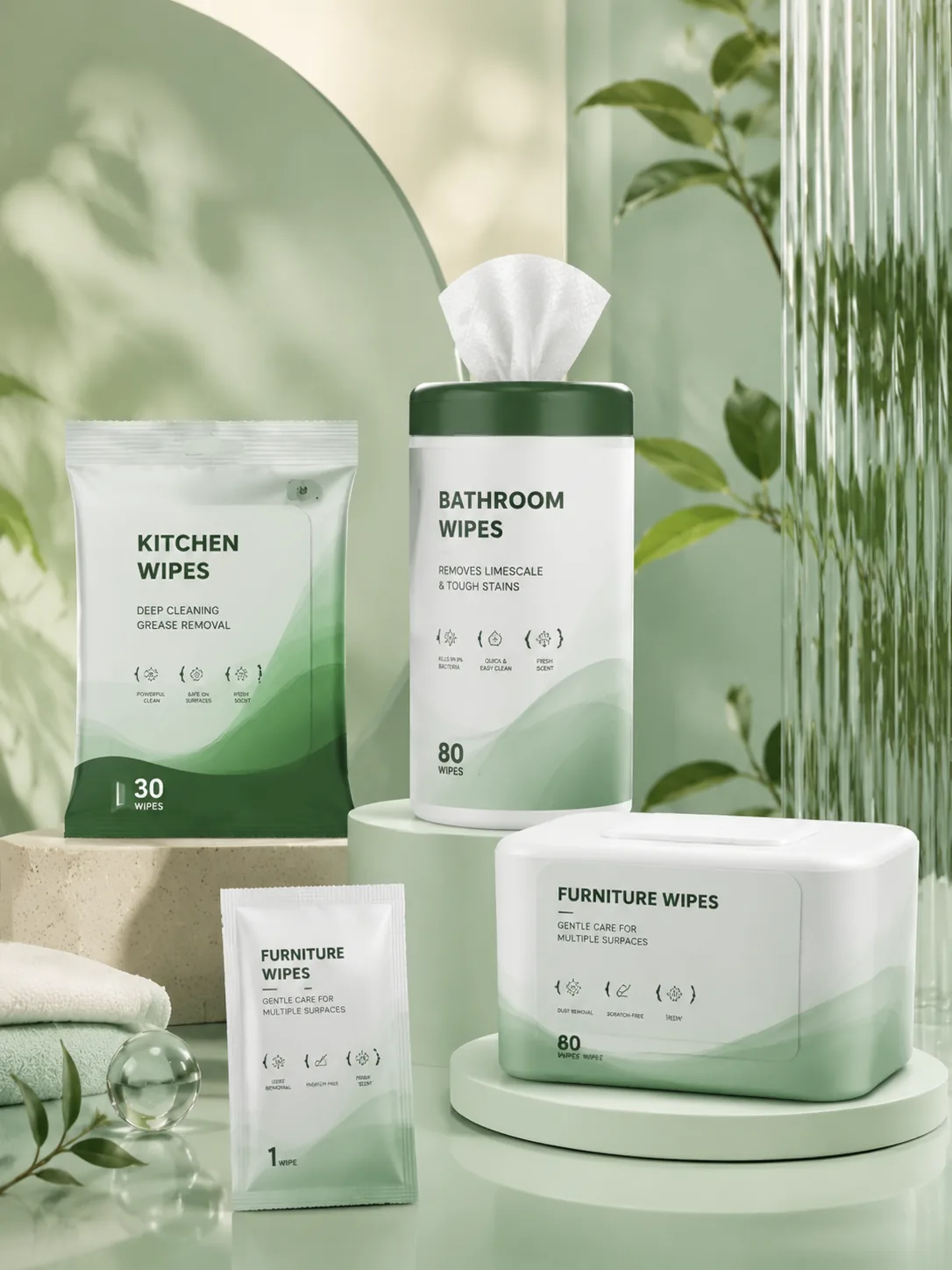
Many brands do not choose one route. A common structure is a stock bottle for the launch range, a refill pouch added once the brand has repeat purchase, and a custom mould only when volume justifies it. The same logic applies across categories — the formats worth investing in depend on where demand is heading, as we set out in our review of household cleaning products to watch over the next six months. Wipes show the effect most clearly: a canister and a soft pack can carry the same sheet count and still deliver very different non-woven area per unit, which we break down in our private label cleaning wipes guide.
—
What In-House Moulding Changes About Packaging Cost
The custom mould route is the one buyers ask about most, because it is the route where the cost is hardest to see before you commit. It also happens to be the one we control most directly.
BIKI Home Care runs its own injection and blow moulding workshop, in the same plant as filling and packing. That changes the economics of a packaging project in six ways.
Cavitation decides the unit cost. A tool that produces more parts per cycle spreads the same machine time across more units. More cavities cost more to build and less to run, and the volume at which that pays back can be calculated before you commit to a mould.
No third-party tooling markup. When a supplier buys moulded bottles or closures from an outside moulder, the tooling cost and that moulder’s margin both end up inside your unit price. Running the tool in-house keeps that layer out of the quotation.
Weight and wall thickness can be tuned, not accepted. Resin is normally the largest single component of a plastic pack’s cost. Because we run the tool, bottle weight can be adjusted during sampling against the strength the product actually needs, instead of accepting whatever the tool happens to produce.
Colour is a machine setting. A new fragrance line in a different bottle colour does not need a new supplier, a new minimum quantity or a new lead time. It needs a masterbatch change and a purge.
Sampling happens in the same week. First-off samples, dimensional checks and a fit test against the actual cap and bottle all take place on one site. A closure that does not sit correctly on the neck is found during sampling, not after 20,000 units have been filled.
One specification across components. Bottle, cap and sprayer are measured against the same drawing, so the parts are designed to fit each other rather than to fit a catalogue.
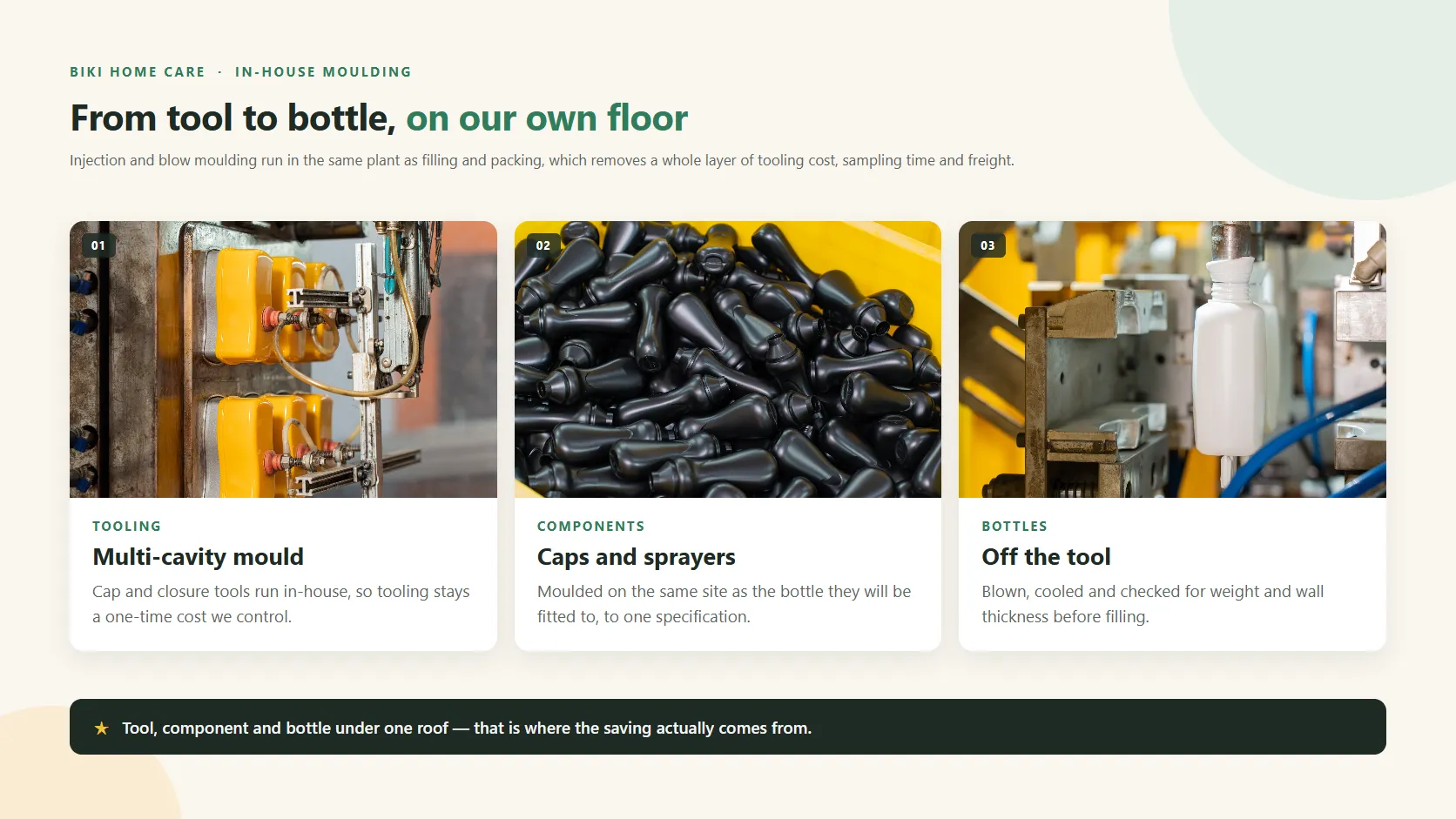
None of this makes custom moulding cheap. Tooling is still a real investment and the MOQ still rises with it. What it changes is how much of that investment you can see, question and adjust before production starts.
—
The Costs That Sit Outside the Quotation
Even a detailed packaging quotation rarely includes everything. These are the items worth asking about before you compare two suppliers.
Label printing plates and setup. Printed labels carry a one-time plate or cylinder cost per design and per colour. A six-colour label with a special finish is not the same setup as a two-colour label.
Colour matching. Matching a specific shade on the bottle, the cap and the label involves three separate processes. Mismatch between them is one of the most common reasons a first production run looks wrong on shelf.
Samples and pre-production approval. Pre-production, stability and transit samples each carry a cost and a lead time. They are also the cheapest form of insurance in the whole project.
Carton and pallet configuration. Carton dimensions that do not divide into the pallet footprint waste container space on every shipment. ISO 3394 sets out modular plan dimensions based on a 600 mm × 400 mm module, and cartons designed around it load more efficiently than cartons designed around the bottle alone.
Compliance and registration. If you sell into the European Union, packaging obligations now sit with the producer, and packaging placed on the market has to meet design requirements. That is a cost line, and it starts at the packaging design stage — not at the border. The specific requirement each component has to meet is set out in our PPWR packaging compliance guide.
Timing. Packaging that arrives late is expensive in a way that never appears on a quotation: air freight, delayed listings and missed promotions. Factory calendars matter here, and the weeks around Chinese New Year are the tightest of the year — which is why we publish a separate guide to planning household cleaning product orders around Chinese New Year.
—
Design Decides Most of the Cost Before Production Starts
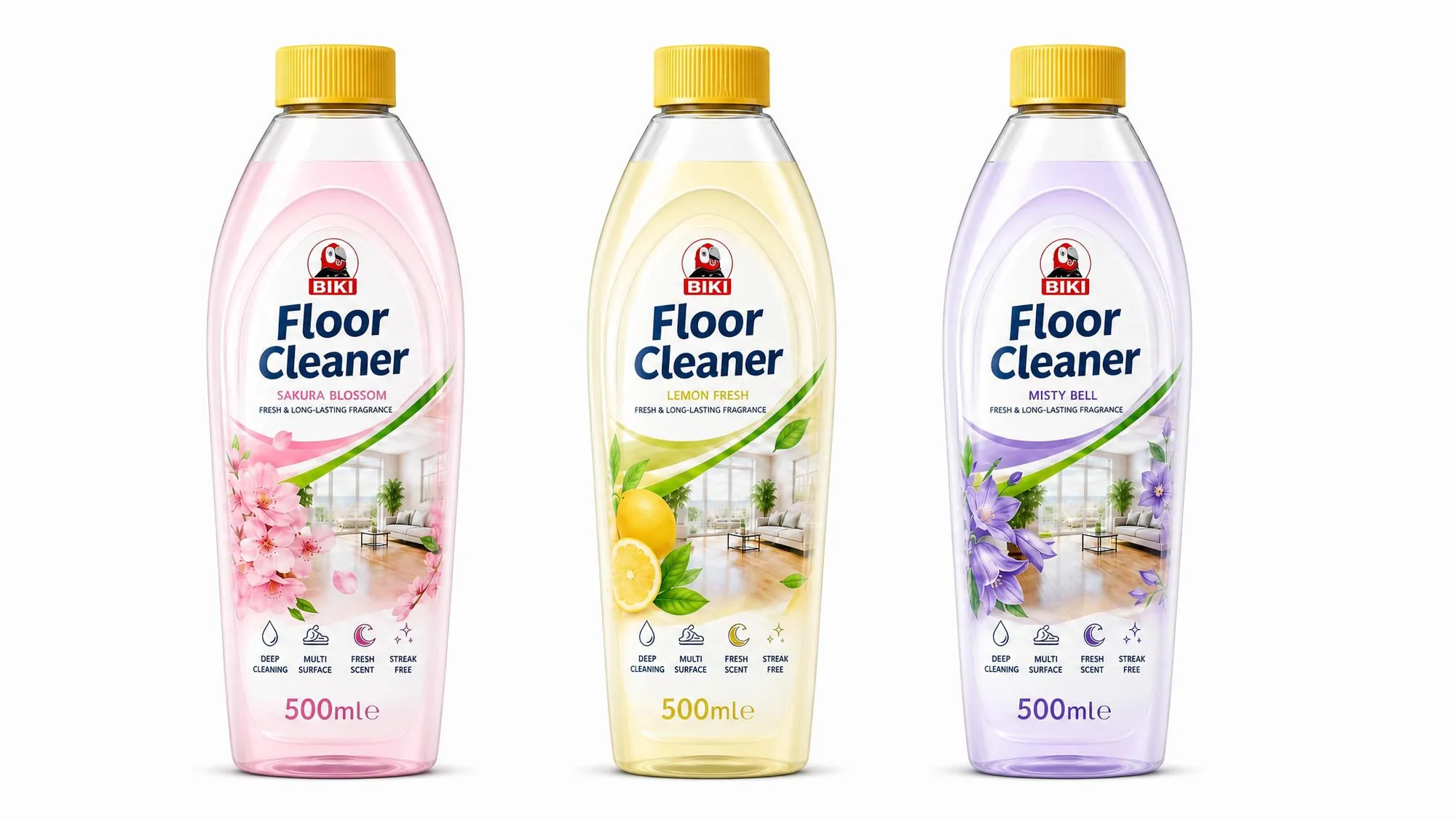
By the time a purchase order is issued, most of the packaging cost is already fixed. Bottle weight, closure type, label material, carton size and pallet pattern are all settled during design.
This is why design is the highest-leverage cost decision in a packaging project — and why a design that ignores production reality becomes expensive later.
A label designed without understanding the bottle’s curvature may need a shrink sleeve instead of a paper label. A bottle specified without checking the filling line may need a new change part. A carton drawn without checking the pallet can cost more in freight for the entire life of the product.
Good packaging design is not decoration applied at the end. It is the point where formula, bottle, label, carton and freight are made to agree. That is also how a product line is built rather than assembled, which is the difference we describe in our guide to developing a private label cleaning product line.
—
Free Packaging Design: What BIKI Includes With OEM and ODM Projects
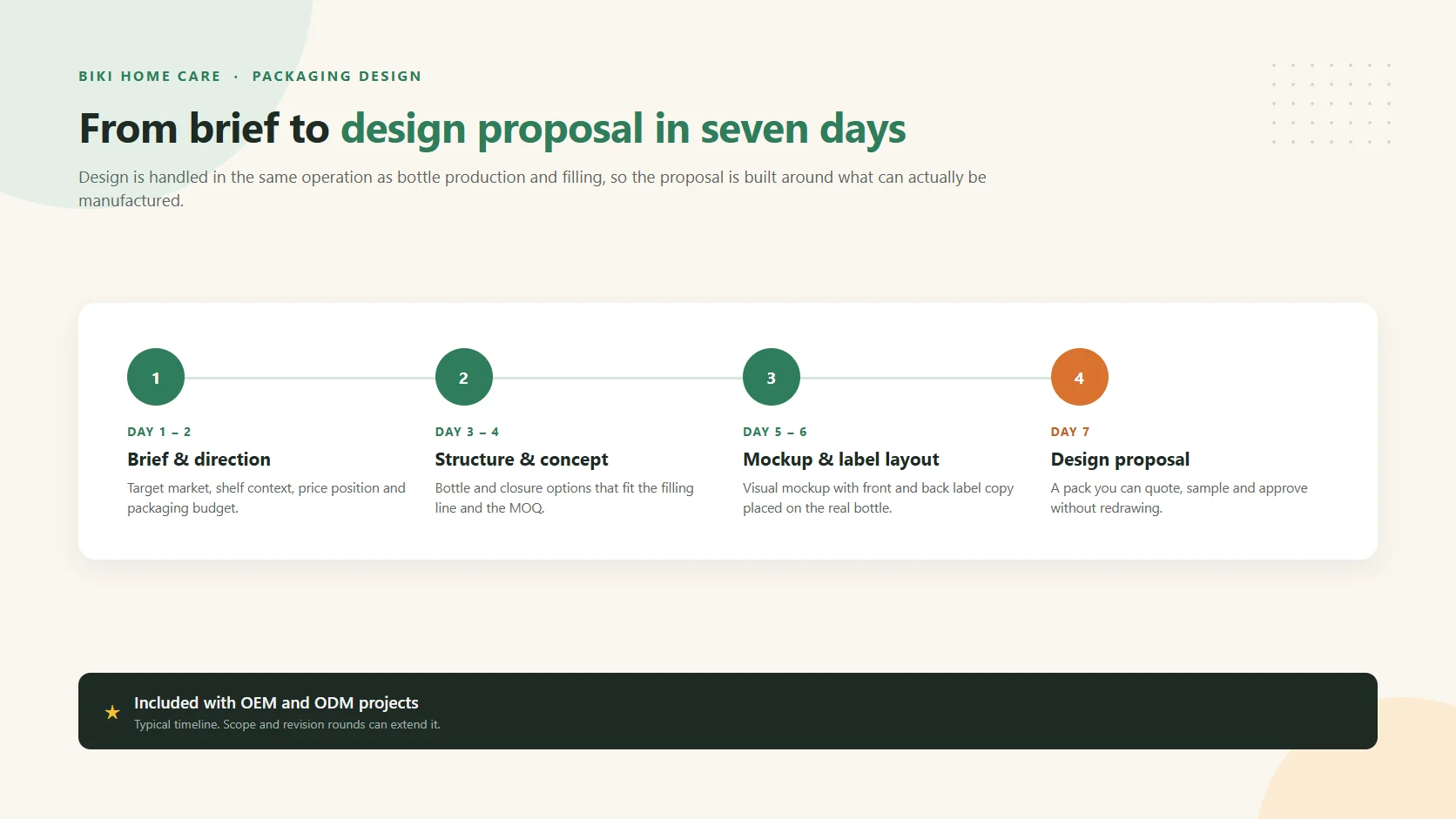
At BIKI Home Care, packaging design is part of the OEM and ODM service rather than a separate design fee. For most projects we can put a design proposal in front of you within seven days of a clear brief.
Day 1–2, brief and direction. We agree the target market, the shelf context, the price position and the packaging budget. The budget matters as much as the brief, because it decides which routes are realistic.
Day 3–4, structure and concept. Bottle and closure options are shortlisted against the filling line and the MOQ rather than against a mood board. Most of the cost is settled at this stage.
Day 5–6, mockup and label layout. A visual mockup with front and back label copy placed on the actual bottle, so you can see the pack instead of imagining it.
Day 7, design proposal. A pack you can quote, sample and approve — not a concept that has to be redrawn once production becomes involved.
The timeline is typical rather than guaranteed. Complex structures, new moulds, regulatory label requirements or several rounds of revision will extend it, and we prefer to say so at the briefing stage rather than after a deadline has passed.
—
What the Free Design Service Covers — and What It Does Not
Being clear about scope saves time for everyone, so here is the honest version.
Included: structural direction, bottle and closure selection from available options, label layout and artwork adaptation, mockups, and a design proposal that is ready for production.
Not included: third-party costs such as new mould tooling, printing plates, external photography, translation and regulatory registration. These are real costs, and they are quoted separately and transparently.
Conditions: the free design service applies to OEM and ODM projects and is scoped case by case, depending on the brief. What we can commit to is the process and the pace — a proposal in days, not months.
For buyers, the real value is not the saved design fee. It is that the design is created by the same operation that will manufacture and fill the product, so it is designed for the line from the first sketch.
—
Why One-Stop Production Removes Cost From the Pack
BIKI Home Care covers the whole chain in one operation: formula development, packaging design, tooling and moulding, bottle production, filling, labelling, carton packing and export loading.
That matters for cost in five specific ways.
Fewer handoffs. When design, bottle production and filling sit in separate companies, every change becomes a negotiation and a delay. In one operation, a change is a conversation.
No design-to-production mismatch. The people who approve the label are the people who run the labelling line. Problems that would otherwise surface at the first production run surface at the design stage instead.
One quality standard. Bottle, cap, label and fill are checked against the same specification, using the same approach we describe in our guide to factory quality control for home care OEM buyers.
Better carton and pallet decisions. Because we pack and load, the carton can be optimised around the pallet and the container rather than around what is easiest to make.
Tooling and filling on one schedule. A new mould and its first fill run sit on the same site, so they can be planned as one schedule instead of two that have to be reconciled later.
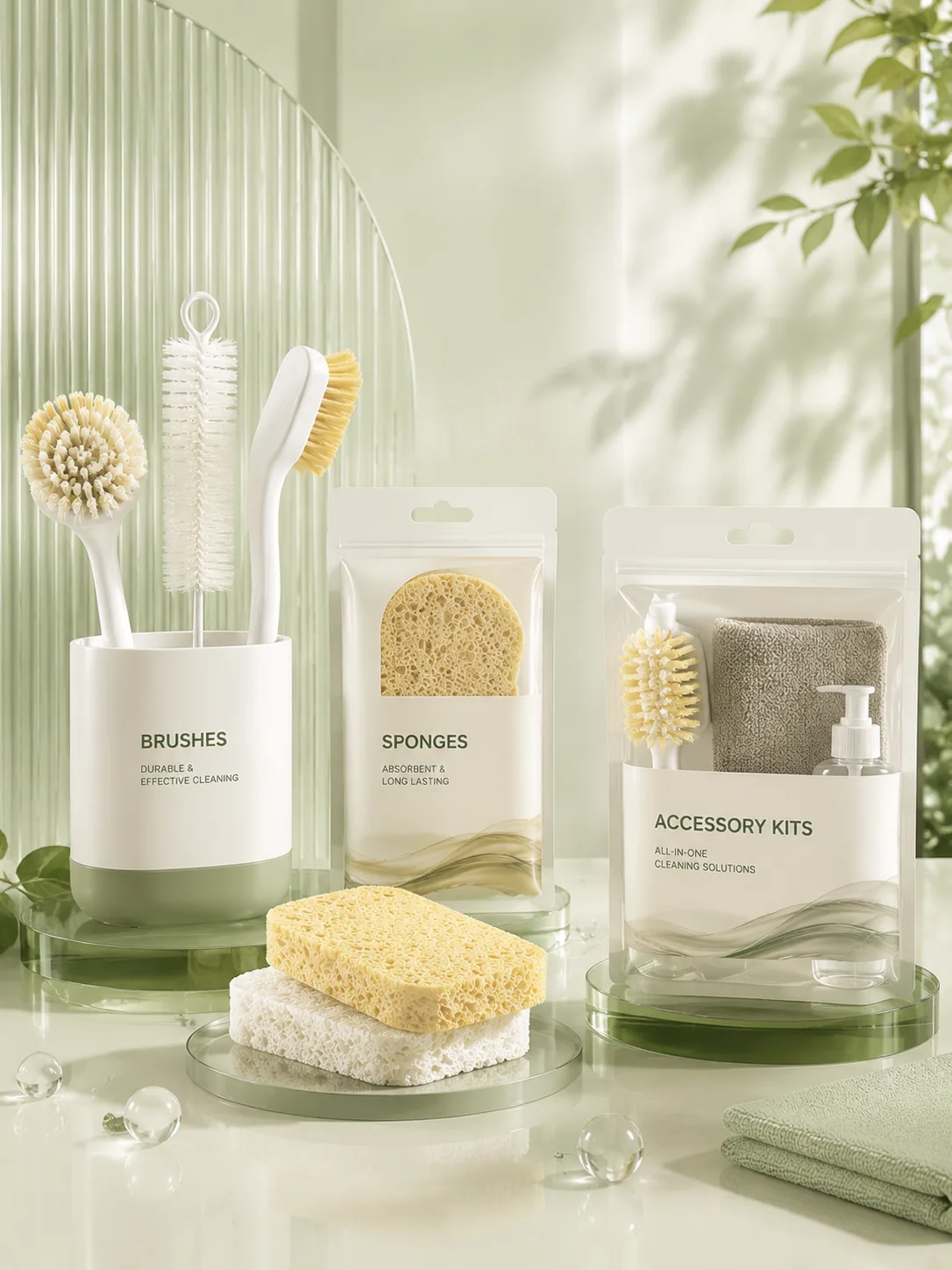
This is also why one-stop production suits brands building multi-product ranges and cleaning kits, where several components have to arrive in one box and look like one brand. We cover that dynamic in why one-stop cleaning kits are winning the private label market.
—
How to Compare Packaging Quotes Properly
If you are comparing two packaging quotations for a household cleaning product, ask for the same eight things from each supplier.
- Unit price at your actual order quantity, not at the MOQ
- Tooling cost, and whether it is one-time or charged again on repeat orders
- Whether the bottle and closure tooling runs in-house or is subcontracted
- Closure and label cost stated separately from the bottle
- Carton dimensions, units per carton and cartons per pallet
- Gross weight per carton and total shipped volume
- Lead time for a repeat order, not only for the first order
- What is excluded — plates, colour matching, sampling, testing and registration
A quotation that answers all eight can be compared with another one. A quotation that gives only a bottle price cannot.
—
A Practical Way to Start
If packaging cost is a live question for your next range, the useful first step is not a price list. It is a short brief.
Tell us the market, the product, the target price and the volume you expect. We will tell you which of the four packaging routes fits, what it costs at that volume, and what the design would look like — usually within a week.
Packaging cost is decided at the design stage. Getting the design right first is the cheapest form of cost control available.
If you are an importer, wholesaler, distributor or private label brand developing household cleaning products, BIKI Home Care can handle formula, packaging design, bottle production, filling and export packing as one project.
Tell us about your:
- Target market
- Product categories
- Packaging format you have in mind
- Expected order volume
- Price position and shelf context
- Private label requirements
Our team can help you choose a packaging route that fits your volume and your price point — and design it around what can actually be manufactured.
Contact BIKI Home Care
Contact person: Derek
Tel: +86 134 2455 2511
Factory address: Area A, No. 37 Chigang Road, Xiaolan Town, Zhongshan City, Guangdong Province, China
Sources
European Commission, Packaging waste. Regulation (EU) 2025/40 on packaging and packaging waste, in force since 11 February 2025 and applicable from 12 August 2026, including the objective that all packaging on the EU market be recyclable in an economically viable way by 2030.
International Organization for Standardization, ISO 3394:2012 — Packaging: complete, filled transport packages and unit loads — dimensions of rigid rectangular packages. Modular plan dimensions, based on a 600 mm × 400 mm module, used to keep cartons compatible with pallet and container footprints.
ISTA, International Safe Transit Association. Pre-shipment distribution testing designed to reduce product damage and optimise package design across the distribution environment.