



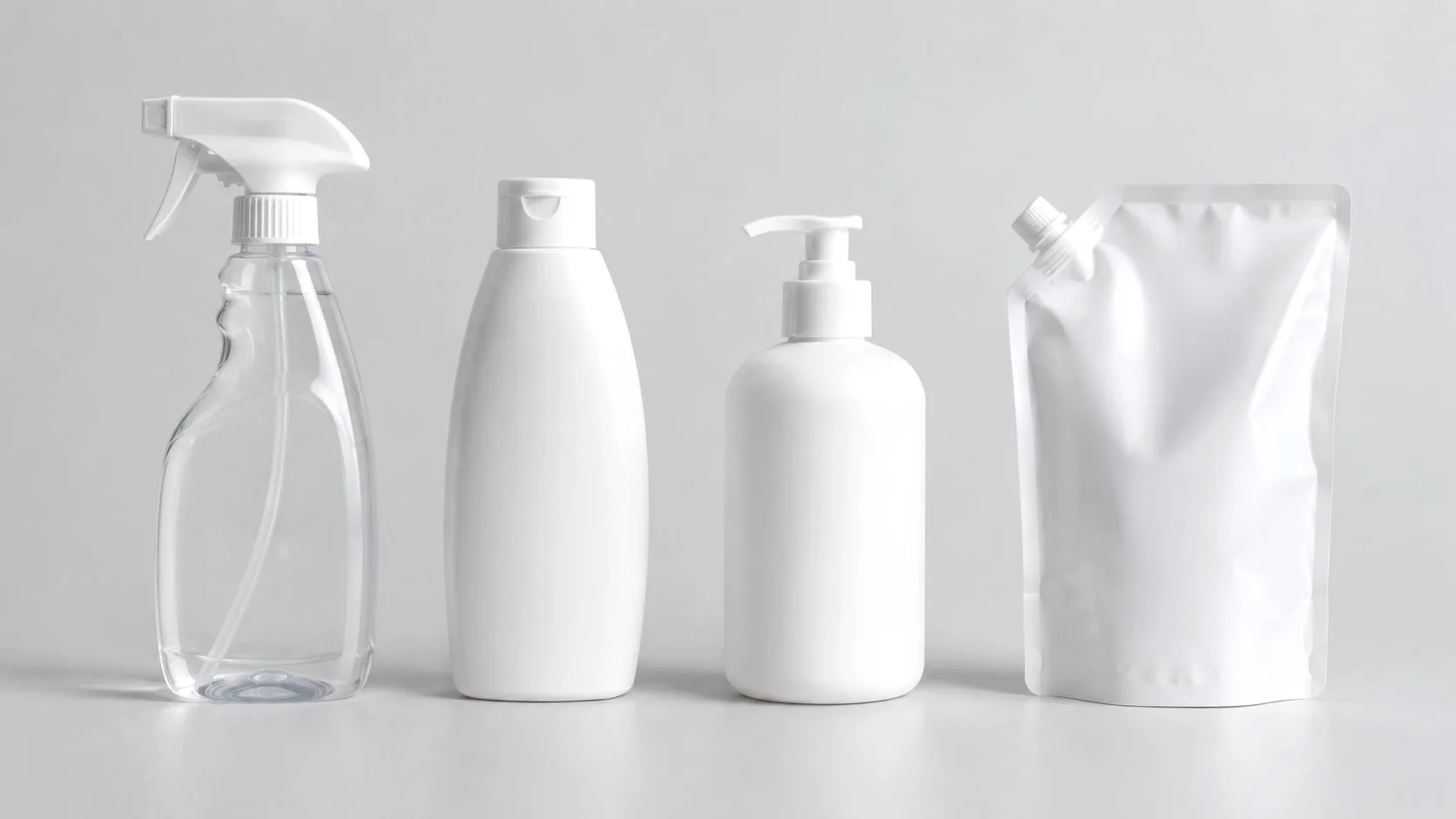
The EU Packaging and Packaging Waste Regulation — PPWR — has applied since 12 August 2026. For buyers of household cleaning products, it is the first packaging rule that decides whether a product can be sold at all, rather than simply how much it costs to dispose of.
Most of the attention has gone to the recycling targets. The part that actually affects an order placed in China is narrower and more practical: the pack has to be designed to a standard, it has to be documented, and someone in the EU has to sign a declaration saying so.
That signature depends on information only the packaging supplier holds.
This guide sets out what has already started, what arrives in 2028 and 2030, where a typical cleaning product pack is most exposed, and what a buyer should ask a supplier before the next order. It is a practical summary for sourcing teams, not legal advice — for a specific SKU, your compliance adviser and the national authority in the market you sell into are the reference points.
—
What Actually Changed on 12 August 2026
The regulation entered into force in February 2025 and replaced the old Packaging and Packaging Waste Directive. From 12 August 2026 it applies directly in every member state, which removes the previous situation where the same box could be legal in one country and not in the next.
What did not happen is a single overnight change to packaging design. The obligations are staged, and confusing the stages is the most common mistake buyers make.
Already in force. Limits on heavy metals — lead, cadmium, mercury and hexavalent chromium together must stay at or below 100 mg/kg. Restrictions on substances of concern. Rules on PFAS in food-contact packaging. Extended producer responsibility, including the requirement to register in each market where packaging is placed.
Already in force, and easy to miss. The documentation chain. Producers must be able to show a conformity assessment and keep technical documentation for five years — ten years for reusable packaging. Importers must be able to demonstrate the assessment was carried out. And suppliers must give the manufacturer the information needed to demonstrate compliance.
That last sentence is the one that matters most for a buyer sourcing from China. It is also the one most often overlooked in a purchase order.
—
The Dates That Decide Market Access
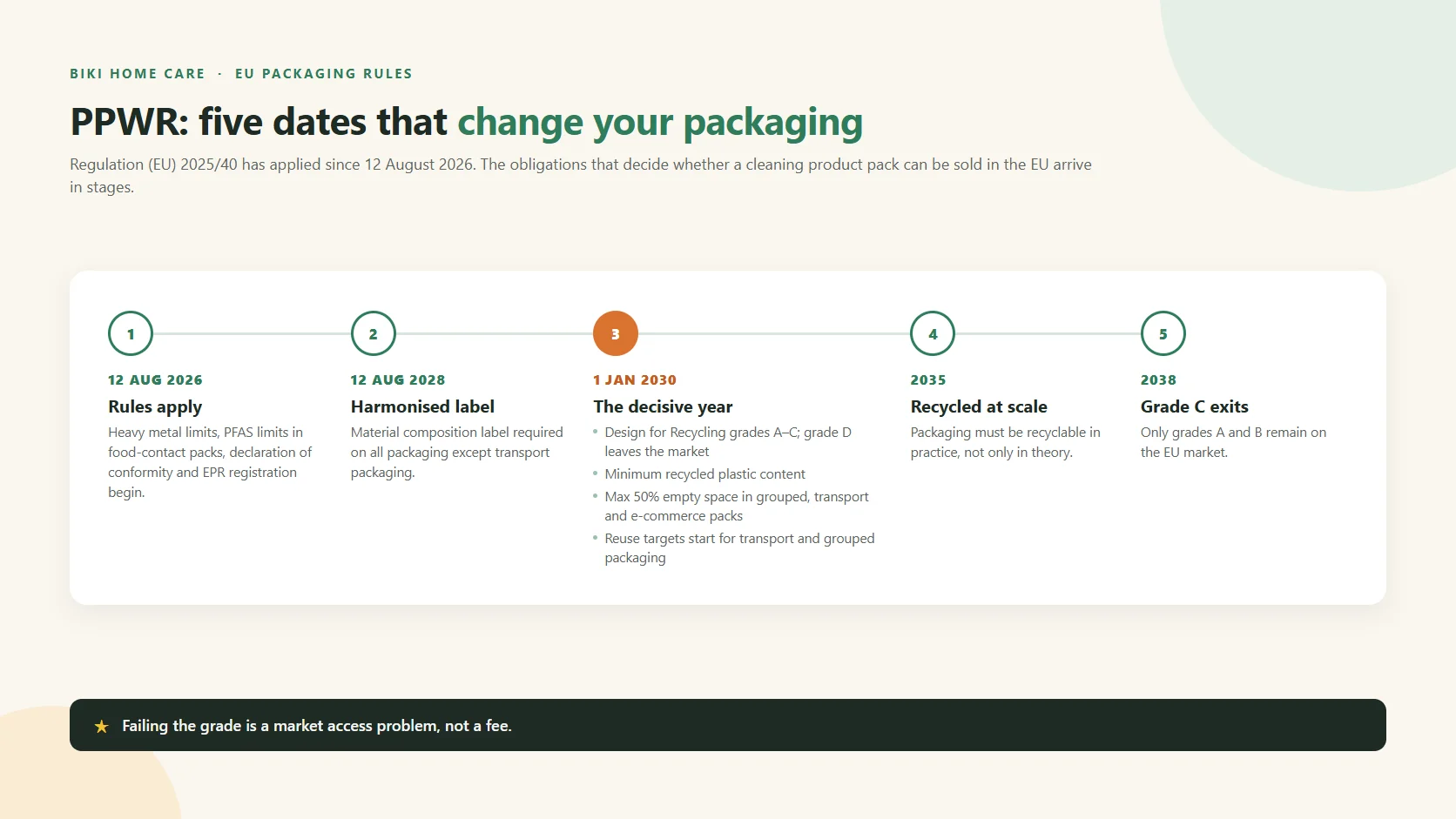
Five dates do most of the work, and the first has already passed. That means the clock is running even for ranges that will not launch until next year.
12 August 2028 — the label. Packaging placed on the market must carry a harmonised label showing material composition, so that consumers sort it correctly. It applies to all packaging except transport packaging. For a cleaning product this usually means a change to label artwork, and artwork changes take longer than people expect because they interact with existing regulatory text on the back panel.
1 January 2030 — the grade. Packaging must comply with Design for Recycling criteria and receive a recyclability performance grade. Grades A to C stay on the market. Grade D does not. In 2038 the bar moves again and grade C also leaves.
This is not a fee. A pack that fails the grade cannot be placed on the EU market, which makes recyclability a product development constraint rather than a sustainability preference.
2030 — the material and the space. Minimum recycled content applies to plastic packaging. Grouped, transport and e-commerce packaging must not exceed 50% empty space. Packaging designed to exaggerate the perceived volume of the product — double walls, false bottoms — is prohibited unless protected by design rights.
2035 — recycled at scale. Packaging must be recyclable in practice, using infrastructure that actually exists, not only on paper.
The detail behind each date is still being written. A large number of delegated and implementing acts will define the calculation methods, the grading thresholds per material and the label format. That is a reason to design for the direction of travel now, not to wait for the final text.
—
Why a Cleaning Product Pack Is Harder Than It Looks
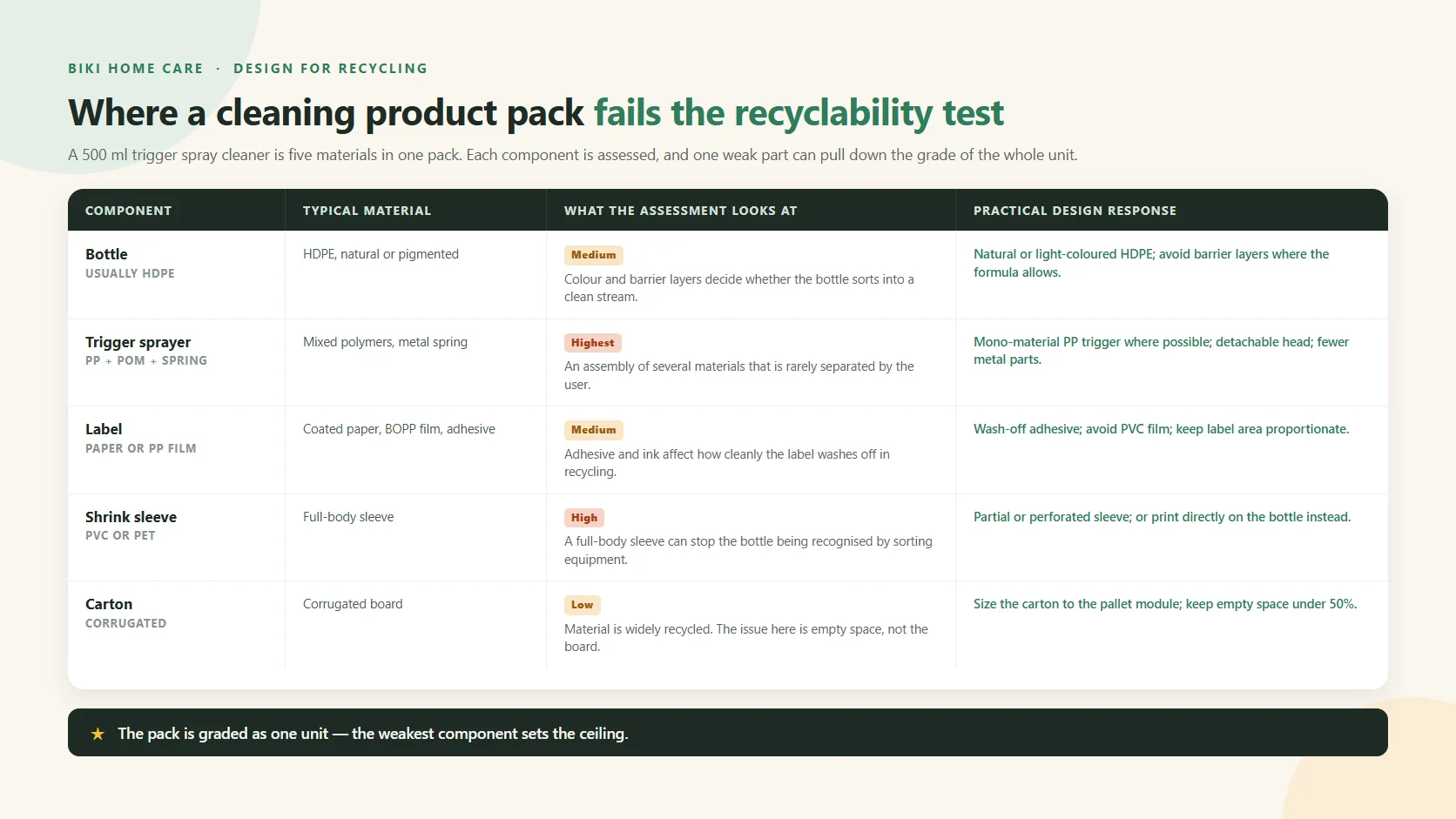
A 500 ml trigger spray cleaner is not one pack. It is five materials assembled into one unit, and the assessment looks at the unit.
That matters because the weakest component sets the ceiling. A perfectly recyclable HDPE bottle with a full-body PVC sleeve and a metal-spring trigger is not a recyclable pack — it is a bottle that will be pulled out of the recycling stream by the parts attached to it.
The bottle. HDPE is one of the better materials to be in. The complications are colour and barrier layers. Dark and carbon-black bottles are harder for sorting equipment to identify, and some barrier constructions interfere with recycling. Natural or light-coloured HDPE grades better and is usually cheaper to produce.
The trigger sprayer. This is the component that decides most spray packs, and it gets its own section below.
The label. Paper or BOPP film with an adhesive. What matters is how cleanly it releases in the wash step of bottle recycling. Wash-off adhesives and avoiding PVC film are the two changes that most often move a pack up a grade.
The sleeve. A full-body shrink sleeve can stop sorting equipment recognising the bottle underneath. Partial sleeves, perforated sleeves, or printing directly on the bottle avoid the problem.
The carton. Corrugated board is widely recycled, so the material is rarely the issue. The issue is the space inside it — which is a PPWR requirement in its own right, and a freight cost as well.
—
The Trigger Sprayer Problem
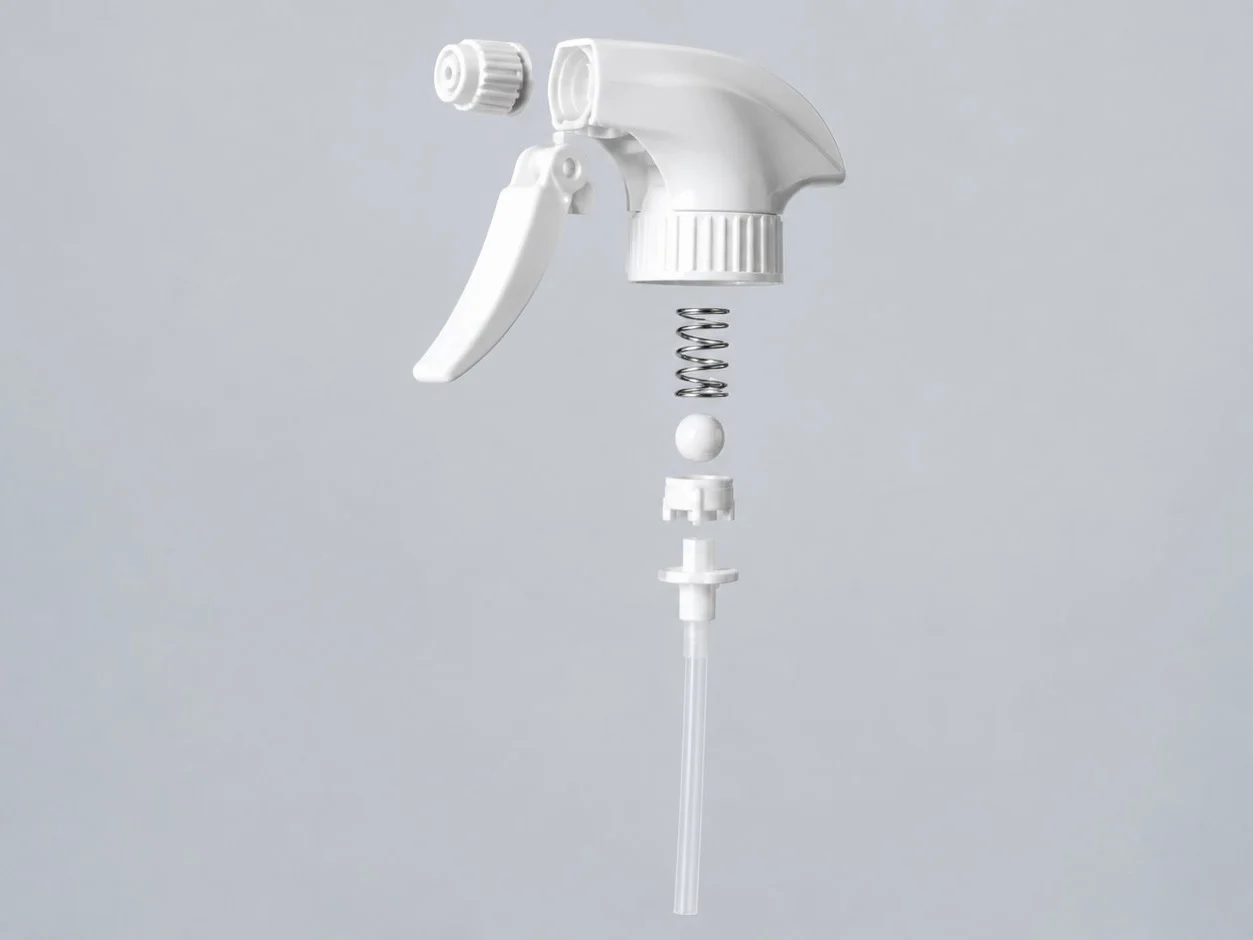
If your range includes kitchen, glass or bathroom sprays, the trigger is where a recyclability grade is most likely to be lost.
A conventional trigger is a small assembly of polypropylene, acetal, a stainless steel spring, and often a silicone or TPE seal. The user does not take it apart. Most recycling systems do not either, so it ends up either attached to the bottle or in the wrong stream.
There are four practical routes, in rough order of impact.
- Mono-material PP trigger. Replace metal springs and mixed seals with PP-compatible designs. Tooling changes are needed, and function has to be re-validated — a trigger that is recyclable but drips is not an improvement.
- Detachable head. Design the sprayer so it can be removed by hand and disposed of separately, with an instruction on the pack. This is a design and labelling change rather than a material one.
- Switch the format. Move the product to a flip-top cap, a disc-top cap or a refill pouch where the application allows. The most recyclable trigger is the one you do not use.
- Keep the trigger, change the rest. If the trigger must stay, make sure the bottle, label and sleeve are as clean as possible so the unit is not pulled down further than necessary.
None of these is free. A mono-material trigger normally costs more per unit than a conventional one, and the tooling change has to be paid for somewhere. The comparison that matters is not trigger cost against trigger cost — it is the landed cost of a compliant pack against the cost of a pack that cannot be sold in the EU after 2030.
Because we run our own moulding workshop, a trigger or cap redesign is a tooling and sampling project rather than a supplier negotiation. We covered how that changes cost in our guide to household cleaning product packaging costs.
—
Recycled Content: The 2030 Material Change

From 2030, plastic packaging must contain a minimum share of recycled material recovered from post-consumer waste. The thresholds differ by category, and the one that applies to most household cleaning bottles is the highest of them.
For plastic packaging outside the food-contact categories — which is where a floor cleaner or a bathroom spray sits — the 2030 threshold is 35%. Contact-sensitive packaging has lower thresholds because of technical and safety constraints that do not apply to a bottle of detergent.
In practice this is less daunting than it sounds for HDPE. Post-consumer HDPE is available and already used in cleaning bottles in several markets. The difficulties are specific:
- Colour consistency. PCR streams vary. If your brand depends on a precise bottle colour, expect more batch variation or a switch to a more forgiving shade.
- Supply by market. PCR availability and quality differ by region, so the same specification may not be achievable everywhere.
- Odour and migration. Relevant for fragrance-led products, where a residual odour in the resin can affect the finished goods.
- Documentation. The percentage has to be evidenced, not estimated. This is a supplier deliverable, not something the importer can reconstruct later.
The simplest way to stay ahead of this is to choose a bottle colour and a resin grade in 2026 that still works at 35% PCR, rather than discovering the constraint during a 2030 redesign.
—
Empty Space and the Carton Nobody Thinks About
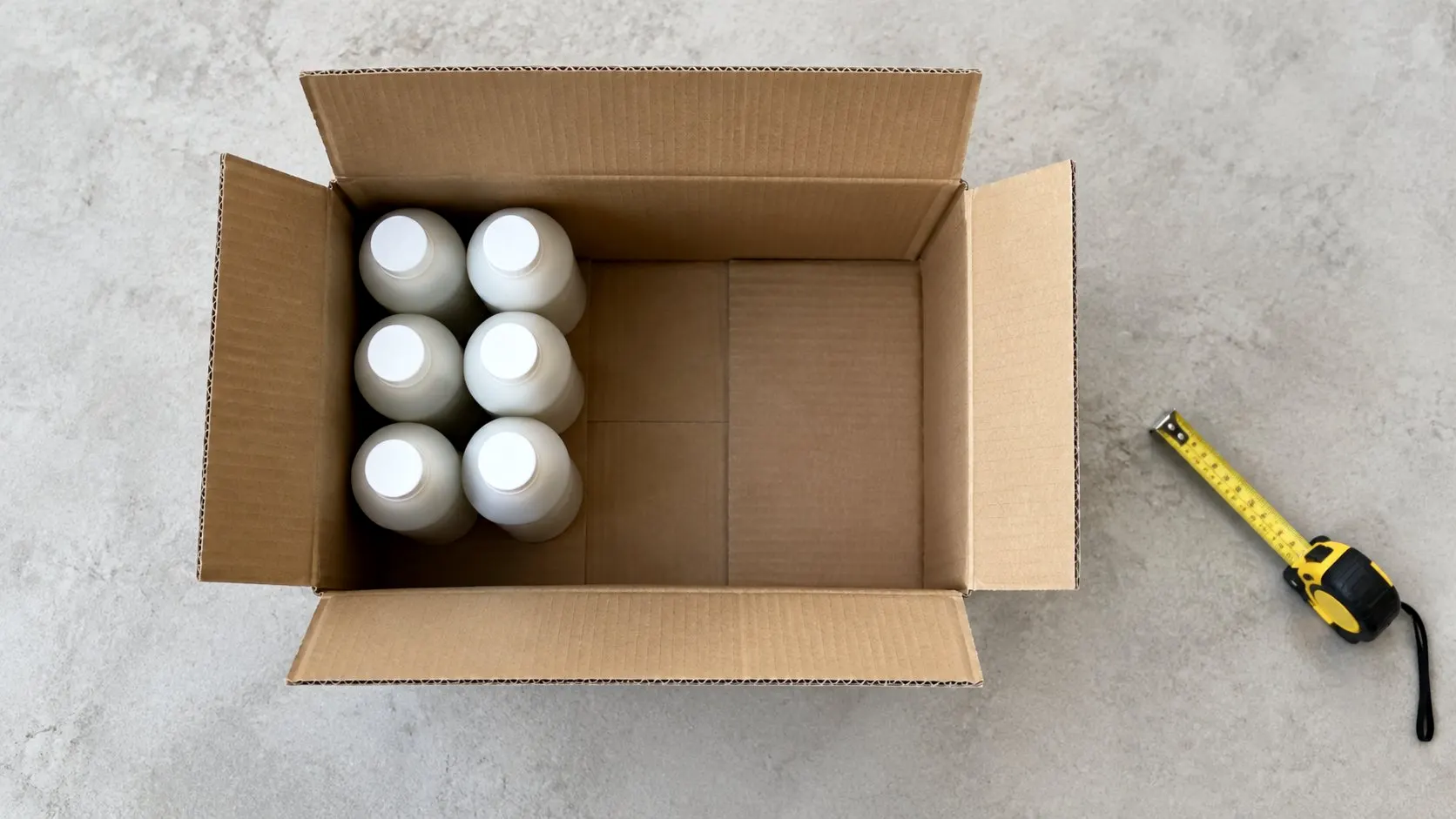
By 2030, grouped, transport and e-commerce packaging must not exceed 50% empty space. For most cleaning product ranges this is a carton specification question, and it is one of the few PPWR requirements that saves money immediately.
A carton that is oversized for its contents costs more in board, more in freight and now risks non-compliance. The fix is usually a carton dimension that divides properly into the pallet footprint — the modular approach we described in the packaging cost guide, based on the 600 mm × 400 mm module in ISO 3394.
The prohibition on packaging that exaggerates product volume matters here too. A bottle with a false bottom or a double wall designed to make a 400 ml product look like 600 ml is not a marketing choice under PPWR — it is a prohibited design, unless it is protected by a design right or trademark.
—
What the Pack Has to Prove, and Who Signs It
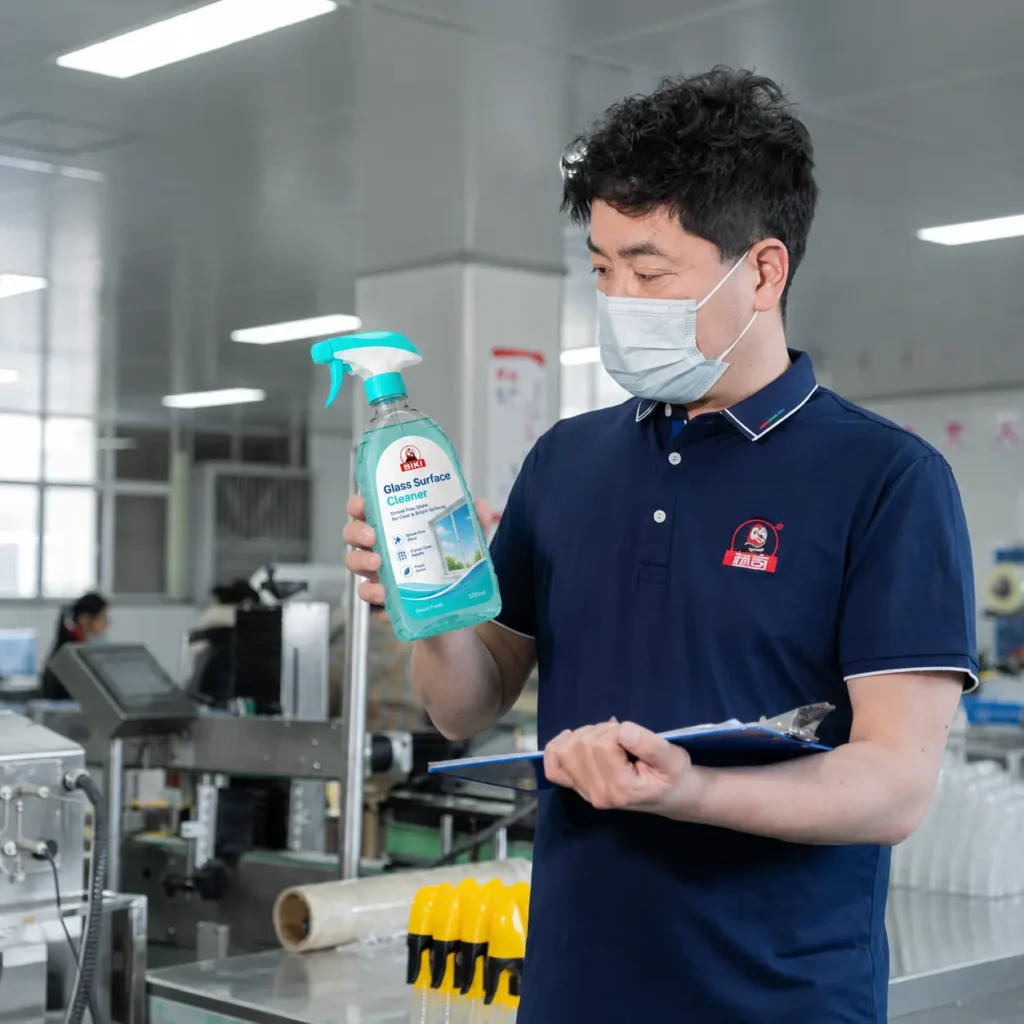
Compliance is not only a design question. It is a paper trail, and the paper trail crosses borders in one direction: from the supplier to the EU business placing the product on the market.
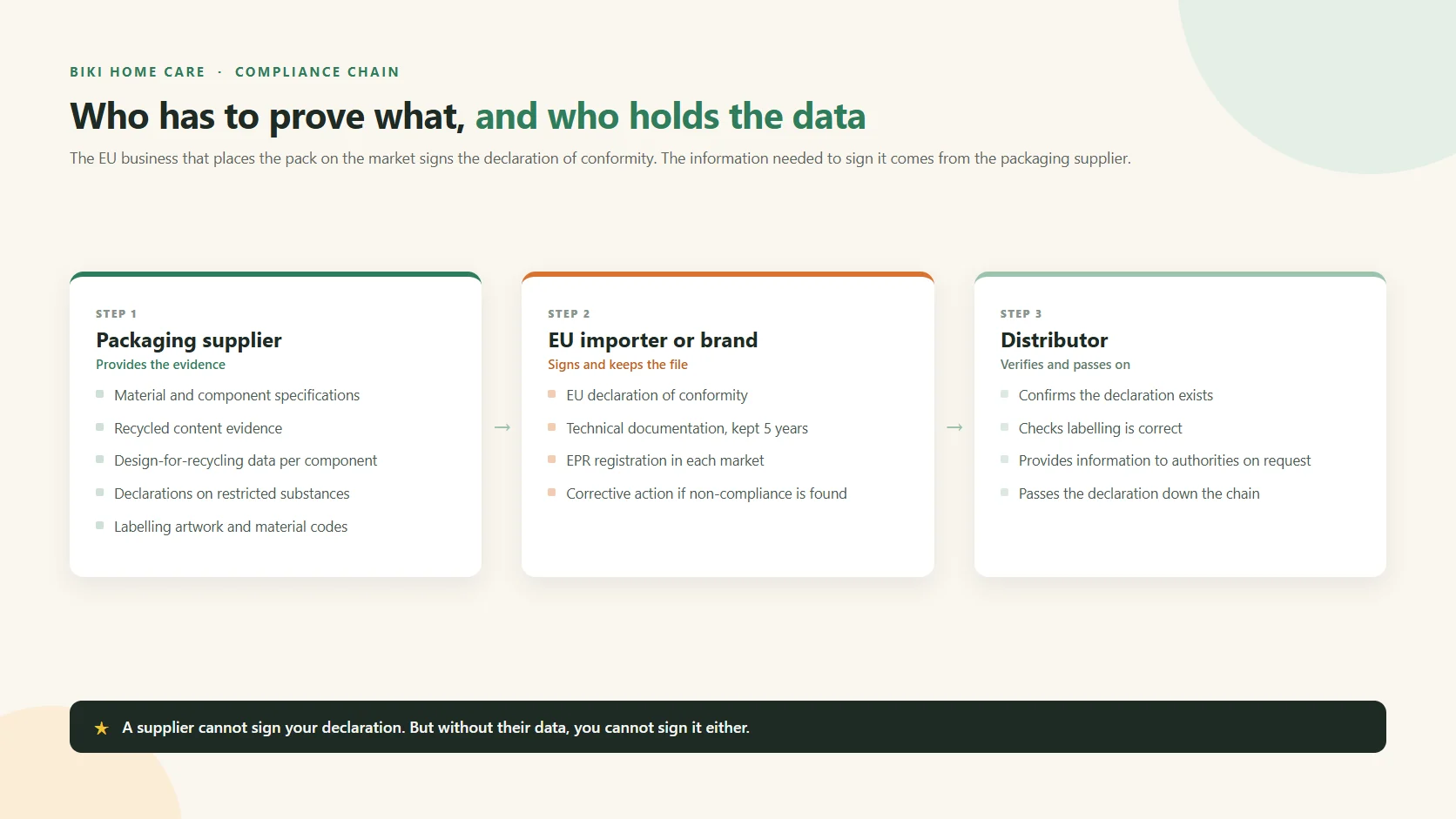
The EU importer or brand owner issues the EU declaration of conformity and keeps the technical file. They cannot do either without component-level information from the manufacturer: material specifications, recycled content evidence, design-for-recycling data and declarations on restricted substances.
This is the part of PPWR that changes how a Chinese supplier is chosen. A supplier who can produce a bottle is not automatically a supplier who can support a declaration of conformity. The capability that matters is being able to answer, in writing, what each component is made of and why it meets the criteria.
One clarification that saves confusion for cleaning products: the PFAS limits in PPWR apply to food-contact packaging. A bottle of floor cleaner is not food-contact packaging, so those specific limits are not the binding constraint. The general restrictions on substances of concern, and the heavy metal limit, do apply.
—
What to Ask Your Supplier Before Your Next Order
These are the questions worth putting in writing, ideally before the artwork is finalised rather than after the purchase order.
- What is each component made of, by weight percentage?
- Is the bottle mono-material, and does it contain any barrier layer?
- What recycled content can you evidence today, and at what percentage?
- Is the trigger or cap available in a mono-material version, and what does the tooling change cost?
- Which adhesive and face material does the label use? Is it wash-off?
- Is the sleeve full-body or partial, and in which polymer?
- What are the carton dimensions, units per carton, and empty space ratio?
- Can you provide a declaration on restricted substances and heavy metals?
- Can the label carry the harmonised material marking from 2028 without a redesign?
A supplier who can answer these without going away to check is a supplier who has already done the work. One who cannot is a risk that lands on your declaration of conformity, not on theirs.
—
How BIKI Supports PPWR Projects
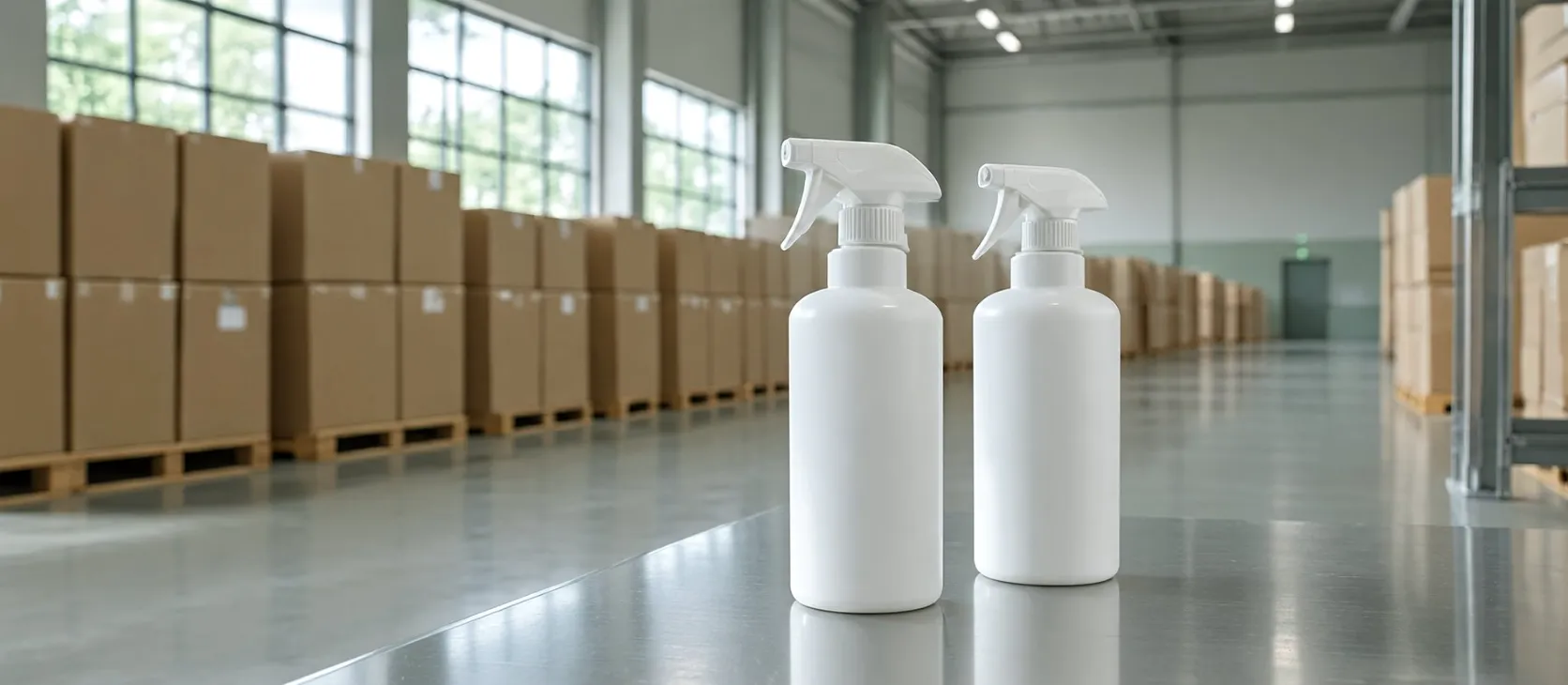
We are a manufacturer, not a compliance consultancy, and we do not sign declarations on a customer’s behalf. What we can do is make the technical side of the file straightforward.
Moulding in-house. Bottle, cap and trigger tooling runs in our own workshop, which means a mono-material redesign is a tooling and sampling project rather than a negotiation with a third-party moulder. It also means we can adjust wall thickness and weight during sampling, which is where a pack’s material use is actually decided.
Component-level specification. Each part of the pack is specified separately, which is the level of detail a technical file needs. We can provide material composition, recycled content evidence where available, and the design data behind each component.
Format alternatives. Where a trigger is the weak point, we can quote the same formula in a flip-top bottle, a disc-top cap or a refill pouch so the recyclability question and the cost question can be looked at together.
Sampling against the specification. Physical samples and dimensional checks happen on the same site as moulding and filling, using the approach we describe in our guide to factory quality control for home care OEM buyers.
If you are still at the stage of defining the range, the earlier decisions are covered in our guide to developing a private label cleaning product line.
—
If You Do Not Sell Into the EU
PPWR does not apply to packaging placed on the market outside the EU, and a large share of our customers ship to West Africa, the Middle East, Latin America and Southeast Asia, where no equivalent rule is in force. The United States is moving in the same direction at state level, on a different legal basis: seven states now operate packaging EPR programs, and what they require from a supplier is a component-level weight record rather than a design grade. We set out that difference in US packaging EPR and the weight data.
Two practical points are still worth considering.
First, the design direction is spreading. Several markets are drafting extended producer responsibility schemes and packaging reduction rules, and a pack designed to the EU standard is normally compliant or close to it elsewhere.
Second, the carton efficiency and recycled content changes usually reduce cost rather than add to it. A carton sized to the pallet module ships more units per container whether or not a regulation requires it.
—
A Realistic Way to Start
The most common mistake is treating PPWR as a 2030 problem. The pack you approve this year will still be in production in 2030, and a redesign at that point is expensive — new tooling, new artwork, new samples, and a gap in supply while all three are approved.
The cheapest sequence is to make the structural decisions now and the cosmetic ones later.
- Choose a bottle material and colour that will still work at 35% recycled content
- Settle the closure and trigger design while the tooling is still open
- Leave room on the label for the harmonised marking before the artwork is signed off
- Size the carton to the pallet module from the first production run
- Ask for the component-level specification at sampling stage, not at shipment
The pack that will be compliant in 2030 is usually the pack that is cheaper to ship today. The two arguments point the same way more often than buyers expect.
If you are planning a household cleaning product range for the EU market, BIKI Home Care can review the packaging format, propose a mono-material or recycled-content option, and provide the component-level information your technical file will need. Tooling and artwork changes take time, and the factory calendar around Chinese New Year is the tightest part of the year — the timing considerations are set out in our guide to planning household cleaning product orders around Chinese New Year.
Tell us about your:
- Target EU markets
- Product categories and pack formats
- Current bottle material and colour
- Whether the range includes trigger sprays
- Expected order volume
- Any recycled content target you have already committed to
Our team can help you choose a format that meets the direction of the regulation and still fits your price point.
Contact BIKI Home Care
Contact person: Derek
Tel: +86 134 2455 2511
Factory address: Area A, No. 37 Chigang Road, Xiaolan Town, Zhongshan City, Guangdong Province, China
Sources
EUR-Lex, Packaging and packaging waste (from 2026). Official summary of Regulation (EU) 2025/40: recyclability performance grades, recycled content, packaging minimisation, the 50% empty space rule, reuse targets and the obligations on manufacturers, importers, suppliers and distributors.
EUR-Lex, Regulation (EU) 2025/40 on packaging and packaging waste. The full legal text, including the annexes setting out restricted packaging formats and the sustainability requirements.
European Commission, Packaging waste. Implementation guidance, the declaration of conformity framework and the timetable for the delegated acts that will define the detailed methodologies.