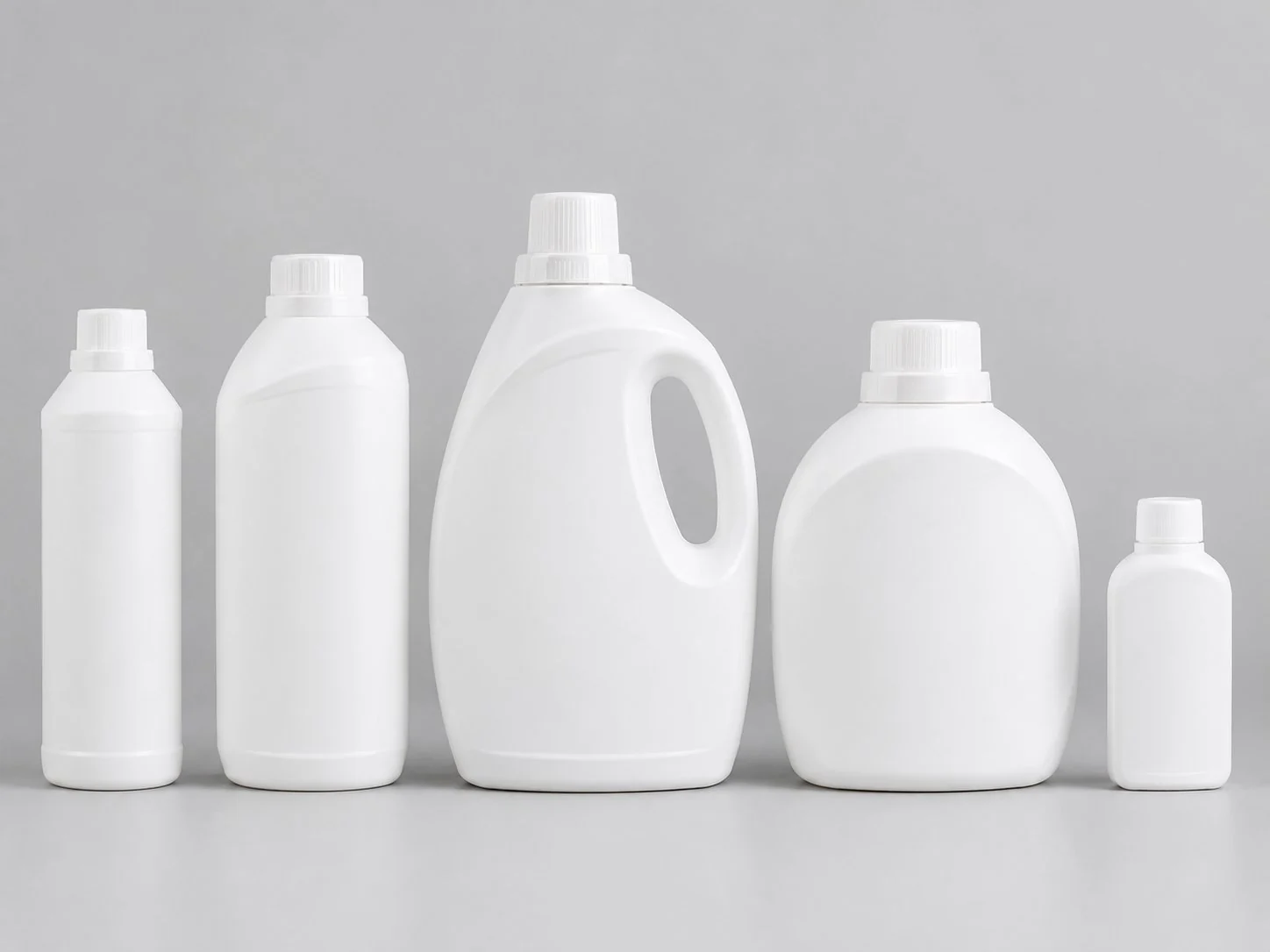
Laundry liquid looks like the simplest product in a household cleaning range. It is also the one most exposed to the paperwork that decides whether a container clears customs.
Importers, distributors, wholesalers and private label teams sourcing household cleaning products usually compare two things when they buy laundry liquid: unit price and fragrance. Both matter. Neither decides whether the product can be sold in Europe after September 2029.
Five formulas cover most of the market. One deadline applies to all five.
So which part of a laundry liquid order actually carries the risk?
What private label laundry liquid covers in a B2B range
The practical takeaway: five SKUs are five market positions, not one formula in five fragrances.
A laundry range looks short on a retail shelf. Underneath, each bottle answers a different buyer question.
- Everyday scented, 500 ml and 1 L in PE, for family wash loads: Floral Fresh Laundry Liquid
- Scent-led, for low-temperature cotton and linen: Chamomile Fresh Laundry Liquid
- Underwear and delicates, 500 ml, built for hand washing: Underwear Cleaning Soap Liquid
- Baby and bedding, 500 ml, low temperature, reusable nappies included: Baby Clothes Laundry Liquid
- Disinfecting, 500 ml to 2 L in PP, the one carrying the regulatory questions: Laundry Disinfectant Liquid
The four everyday variants share a neutral pH and a 36-month shelf life. The disinfecting variant runs to a 2 L PP jug with a handle, because that is how it is bought.
New buyers often assume the five are one base with different fragrance. That survives until the first sample round. A hand-wash product for silk and a machine product for cotton pull in different directions on foaming, rinsing and surfactant load. The same assumption breaks in wipes, where sheet size and pack format change the product more than fragrance does — we set that out in our private label cleaning wipes guide.
The practical takeaway: decide the position first, then the formula. Reversing the order costs a sample round.
Laundry liquid formula variables buyers actually compare
The practical takeaway: agree pH and active matter before fragrance, or you will re-sample twice.
Six variables move price and performance together. Buyers raise them in the wrong order.
- Active matter, meaning total surfactant content, is the largest single cost line
- pH decides labelling and transport, and gets its own section below
- Enzymes, usually protease and lipase, add cost and shorten the list of markets that accept the formula
- Optical brighteners are rejected by some private label programs outright
- Fragrance load separates a 0.3% formula from a 0.8% formula by a visible margin per unit
- Viscosity and appearance, clear against opaque, change what a shopper assumes about strength
Fragrance is the variable buyers raise first and should settle last. Raising the load to cover a thin formula rarely works. And the same fragrance at the same percentage smells different on a different surfactant base, so identical fragrance costs can produce products that do not smell alike.
The practical takeaway: put active matter and pH in writing before anyone opens a fragrance sample box.
Why neutral pH decides your laundry liquid label
The practical takeaway: pH is a packaging decision as much as a formula decision.
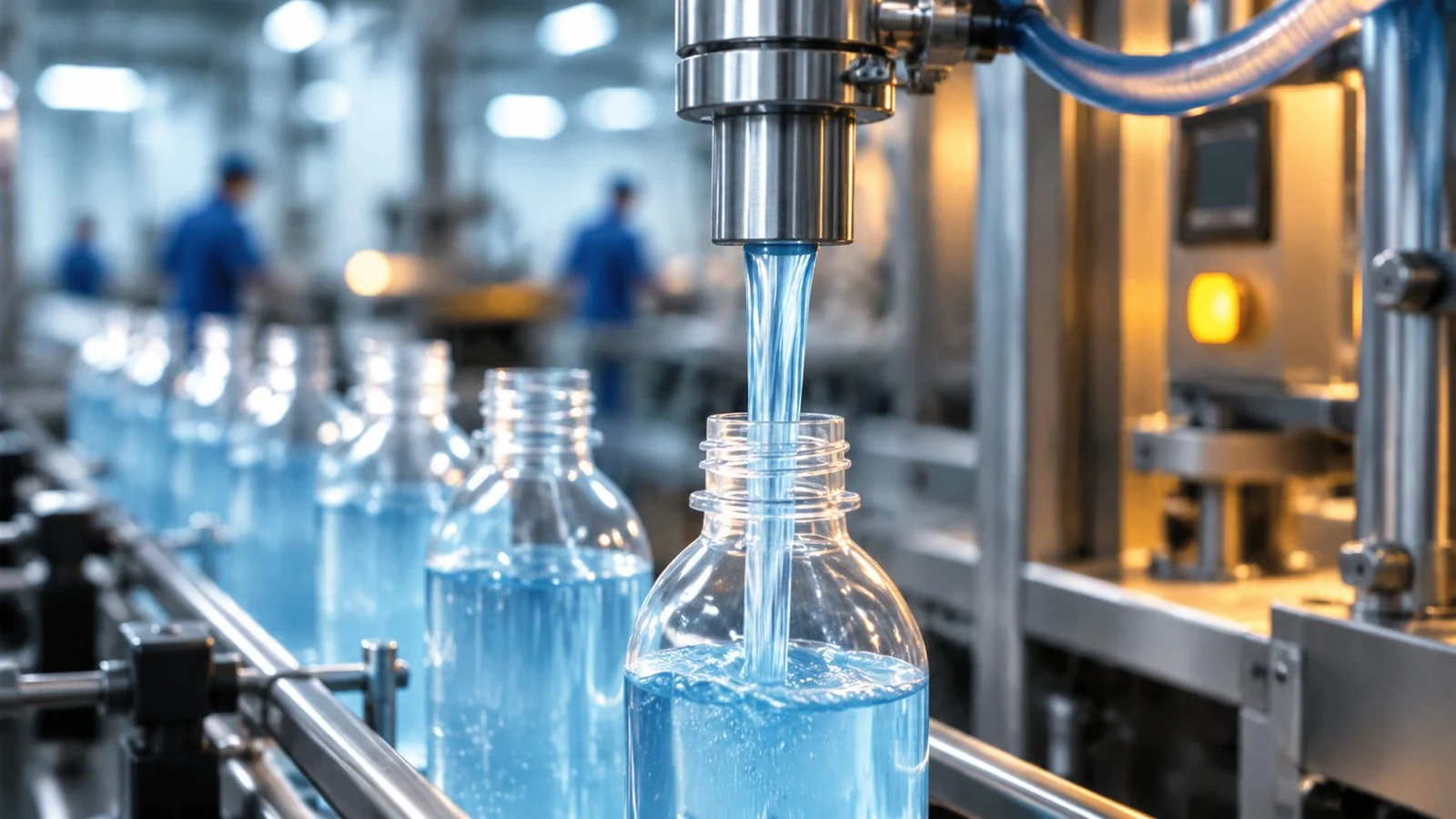
CLP Annex I sets a threshold that decides what kind of product you are shipping. In the absence of other information, a mixture is classified as Skin Corrosion Category 1 if it has a pH of 2 or below, or 11.5 and above.
That single line decides the pictogram, signal word, hazard statements, transport classification and whether the pack needs a child-resistant closure.
A neutral laundry liquid sits well away from both ends of that range. That is the practical reason most private label laundry formulas are neutral. The alkaline version may clean better on certain soils, and arrives with a label most retail buyers will not put on a family shelf.
One caution. Neutral is a pH statement, not a safety statement. Do not let a supplier turn it into a claim about skin tolerance unless the file supports it. And where a product is classified as corrosive, CLP Article 35 requires child-resistant fastenings or a tactile warning for packs sold to the public. That is the legal basis for a press-and-turn cap, not a design preference.
The practical takeaway: ask for the pH value and the SDS together. One without the other tells you nothing useful.
Bottle, cap and refill formats for laundry liquid OEM
The practical takeaway: the packaging chain closes before the filling plant does.
Laundry liquid ships in a narrow set of formats, and the format drives the schedule.
- 500 ml and 1 L in PE for the everyday and baby variants
- 2 L PP with a handle for the disinfecting variant
- Refill pouch for buyers building a concentrated or refill program
- Refill bottle where the channel wants a reusable container
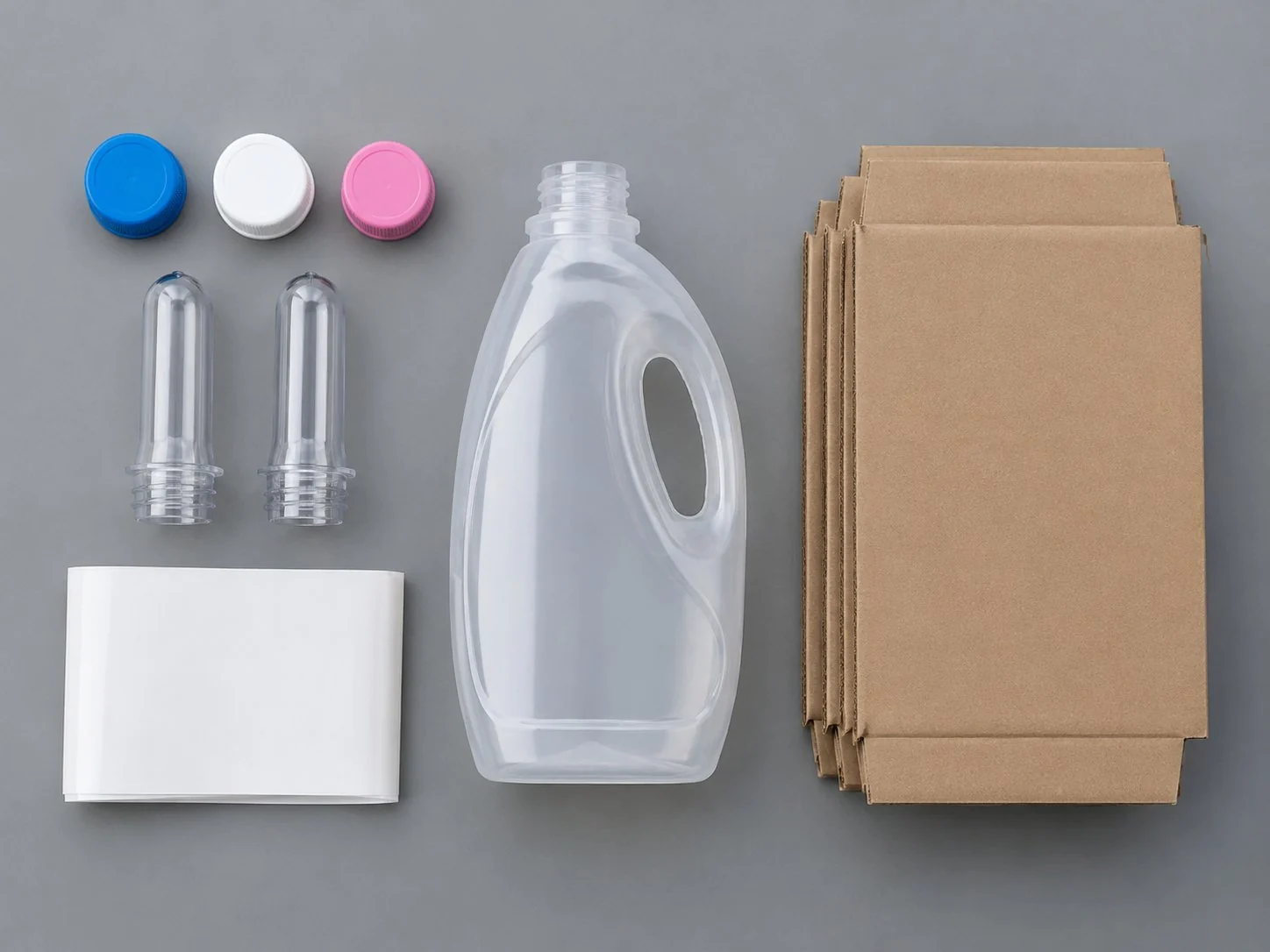
Bottle blowing, cap molding, label printing and carton conversion are four separate operations, and in most factories all four are outside companies, most smaller than the plant that fills the liquid. They close earlier for holidays and fill up earlier in a busy season.
Two of the four can be brought inside. We blow mold the PE and PP bottles and injection mold the caps on site, in the same building as the filling lines, so a 2 L handled jug and its cap are not ordered from anyone. Labels and cartons come from dedicated suppliers.
The difference shows in the details. A color change on a shape already tooled needs no new mold, so a late decision does not restart the packaging clock. A filling slot cannot be lost because a bottle supplier ran short of resin or closed a week early. And when a neck finish does not seal, the bottle, the cap and the liquid are on one site, which makes it a production problem instead of a three-way argument.
The practical takeaway: ask which components are made inside the plant and which are bought in, and get the lead time of each bought-in part in writing. That lead time never appears on a quotation.
What drives laundry detergent manufacturing cost
The practical takeaway: a 10% lower quote usually means one grade down in active matter.
- Active matter, priced per percentage point and the biggest lever
- Fragrance, priced per kilogram and charged at the declared load
- Bottle, cap and label, priced per unit and sensitive to order quantity
- Carton and shrink film, small per unit and easy to underestimate in a container
- Filling loss and changeover time, which show up in a quote as nothing at all
- MOQ steps, where the per-unit price drops in visible increments rather than smoothly
Two quotes can differ by 12% and both be honest. The difference sits in a number the buyer was not given: active matter percentage. A supplier who will not state it is asking you to compare prices without a denominator.
Doubling an order rarely halves the unit price. It moves you to a different bottle and carton price, and the formula cost barely moves.
The practical takeaway: compare quotes on active matter, not on unit price alone.
The EU detergents regulation that changes laundry liquid sourcing
The practical takeaway: ask what happens to your SKU on 24 September 2029.
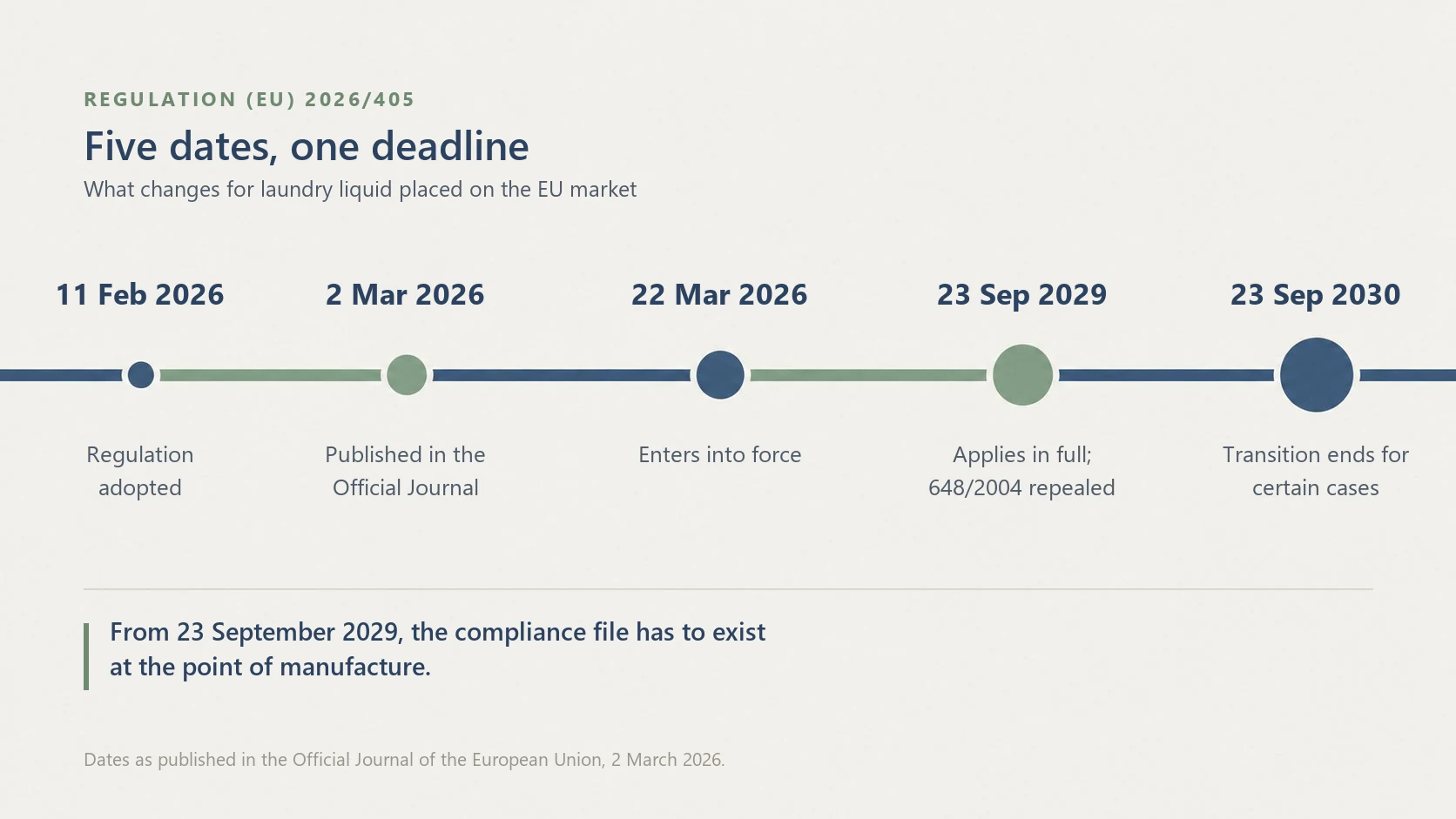
Regulation (EU) 2026/405 replaces Regulation (EC) No 648/2004, the framework for two decades. Buyers plan ranges against these dates.
| Milestone | Date |
|---|---|
| Regulation adopted | 11 February 2026 |
| Published in the Official Journal | 2 March 2026 |
| Enters into force | 22 March 2026 |
| Applies in full, 648/2004 repealed | 23 September 2029 |
| Transition ends for certain cases | 23 September 2030 |
Three changes reach a manufacturer outside the EU directly.
The first is the digital product passport. In plain terms, every detergent placed on the EU market needs a machine-readable record holding the product identity, the responsible operator, the declaration of conformity and the composition data. Customs can read it at release. A container without one is not a slow container. It is a container that cannot be cleared.
The second is the authorised representative. A manufacturer established outside the EU must appoint a representative inside the EU before placing products on the market. That obligation did not exist in this form under 648/2004.
The third is where the paperwork sits. Conformity assessment, technical documentation and the EU declaration of conformity now belong to the manufacturer rather than the importer. The importer used to hold the compliance file. Now it has to exist at the point of manufacture, in a form a market surveillance authority can check without asking anyone.
The practical takeaway: the compliance file is now a factory deliverable, not an importer task.
Phosphate limits in laundry liquid: what changed and what did not
The practical takeaway: phosphate limits are not new. Anyone telling you they are has not read the file.
Several summaries of the new regulation describe a new phosphate restriction for laundry detergents. That is not what happened, and the distinction matters when you brief a factory or a retail buyer.
The limits were set in 2012. Regulation (EU) No 259/2012 amended 648/2004 to cap phosphorus in consumer laundry detergents at 0.5 g per recommended dose from 30 June 2013, and in consumer automatic dishwashing detergents at 0.3 g per standard dose from 1 January 2017.
The 2026 regulation keeps phosphate restrictions inside the new framework. It does not invent them. What is new is that the restriction now sits beside a conformity file, so a declaration has to be traceable rather than assumed.
For buyers the question is unchanged: is it phosphate-free, and will the supplier put that in writing on the specification. Phosphate-free is a formulation choice, not a performance claim. Builders still do the work phosphate used to do, so ask what replaced it.
The practical takeaway: request the phosphate declaration in writing, and ask what the builder system is.

Laundry liquid manufacturer or trading company
The practical takeaway: a trading company can quote faster and cannot tell you why a batch failed.
Most private label laundry liquid exported from China is sold through an intermediary. That is not automatically a problem. It becomes one when the intermediary is presented as the plant.
Signals worth checking:
- Whether it can show a filling line, not only a warehouse
- Whether it can explain what happens when a batch fails a pH or viscosity check
- Whether the quotation address matches the certificate address
A useful test is one backward question. Take a finished carton code and ask which bulk batch and which material lots produced it. A plant answers in minutes. An intermediary changes the subject.
The practical takeaway: follow one lot backward before you place a first order.
Sampling and approval for a first private label laundry order
The practical takeaway: expect two rounds, and budget time for both.
A first laundry order runs through two sample stages that answer different questions.
Round one is a lab sample in a plain bottle. It confirms the formula direction: appearance, foam behavior, rinse feel, and whether the fragrance survives a wash cycle.
Round two is a production-representative sample in the final pack. This one matters commercially, because it shows the product as the shopper meets it, at the fill level the line will actually run.
Two details decide whether round two is useful.
Confirm the fragrance before the bottle artwork is signed off. Artwork revisions triggered by a fragrance change are the most common cause of a delayed first run.
Check the fill level against declared net content, not against how full the bottle looks. A 500 ml bottle with a large shoulder can look under-filled at a correct 500 ml.
The practical takeaway: approve the pack as it will ship, not the bottle on a design file.
Export packing and container loading for liquid detergents
The practical takeaway: liquid is dense, so a container runs out of weight before it runs out of space.
A container of laundry liquid reaches its weight limit with volume still available. Partial shipments and top-ups cost disproportionately, because you pay for a container and use part of it. Air freight is not a real fallback either. The economics do not survive the density.
Practical consequences for the buyer:
- Plan the full quantity, not 80% with an intention to top up
- Confirm carton compression strength against the stack height in the container
- Check whether the carton carries the weight four high in a humid hold
- Agree shipping marks early, because re-marking cartons after loading is not a thing
Carton failure in a liquid shipment is rarely a carton problem. It is a stack height problem or a moisture problem, and both are decided before the container is loaded.
The practical takeaway: book the full container, and check stack height before the cartons are made.

Laundry liquid lead times and the Chinese New Year window
The practical takeaway: the holiday is eight days. The disruption is six to eight weeks.
Standard lead time on the everyday variants is within 30 days from confirmation, assuming bottle, cap, label and carton are available.
Chinese New Year 2027 falls on 6 February, eleven days earlier than 2026. The statutory holiday is short. What happens is longer: output falls from early January, production stops around 30 January, restarts around 20 February at a third of the workforce, and reaches normal capacity in mid to late March.
Working back from a production-complete date of about 19 January:
| Lead time | Order confirmation needed by |
|---|---|
| 90 days | about 21 October 2026 |
| 60 days | about 20 November 2026 |
| 45 days | about 5 December 2026 |
| 30 days | about 20 December 2026 |
The last realistic sailing before the shutdown is around 30 January. After that, goods wait until late February.
What catches buyers is not the holiday length. It is that the packaging chain closes earlier than the filling plant, so a 30-day order placed in December is not a 30-day order. For the full calendar, see the Chinese New Year 2027 sourcing calendar.
The practical takeaway: add three weeks to every pre-holiday date you are given.
Private label laundry liquid: common questions
What is the minimum order quantity for private label laundry liquid?
There is no single company-wide figure. The break point depends on the bottle, cap, carton and formula, so any supplier quoting one before seeing your pack is guessing. Send the pack and the target volume.
Can you match a laundry liquid formula we already sell?
Often, subject to the ingredient disclosure you can share and the markets you sell into. Matching a competitor product takes longer than matching your own, because the starting point has to be reverse-engineered.
Which bottle sizes are standard for laundry liquid OEM?
500 ml and 1 L in PE cover most everyday and baby variants, 500 ml alone for underwear and delicates, and 500 ml to 2 L in PP for the disinfecting variant. Refill formats have their own component chains.
Can you supply the bottle and the cap as well as the liquid?
Yes. Bottles are blow molded and caps injection molded at our site in Zhongshan, so a private label order can start from the container rather than from a bottle supplier’s schedule. Labels and cartons come from dedicated suppliers.
Is your laundry liquid phosphate-free?
Yes. The range is formulated phosphate-free, and we state it on the product specification so it sits in your technical file rather than an email.
How long does a private label laundry liquid order take?
Within 30 days from confirmation on the standard variants, assuming components are available. Add two to three weeks for a foam pump, trigger, dispensing cap or refill pouch, because those are bought in.
Do you supply the data needed for an EU digital product passport?
We can provide the product and composition data that goes into your technical file. The passport itself is normally assembled by the operator placing the product on the EU market, so the useful conversation is which fields you need.
The practical takeaway: ask for the specification sheet first, then the price.
Working with a laundry liquid manufacturer
At BIKI Home Care, we manufacture household cleaning products in Zhongshan, Guangdong, and produce the five laundry liquid positions described above: everyday scented, scent-led low temperature, underwear and delicates, baby and bedding, and disinfecting. The bottles and caps for all five are made in the same building. The range is phosphate-free and formulated at neutral pH, with a 36-month shelf life on the standard variants and lead time within 30 days. These products already ship into European and North American markets.
For a new range, the useful first conversation covers the position you want, the market you sell into, the pack format and your label timing. The OEM and ODM service overview sets out the cooperation models, the cleaning products factory page covers the site, and the liquid cleaner range lists the formats in production. Buyers building a European pack should read the PPWR packaging compliance guide alongside the regulation notes above, and the packaging cost breakdown explains the per-unit figure.
Not every brief should be accepted. If your volume, your pack or your deadline does not fit what the line can do, the useful answer is no, and it is better to hear that before the artwork is approved.
Have a product idea for your market?
Talk to our team about your next household cleaning project.
Sources
European Union, Regulation (EU) 2026/405 on detergents and surfactants, repealing Regulation (EC) No 648/2004. Adopted 11 February 2026, published in the Official Journal 2 March 2026, in force 22 March 2026. Repeal of 648/2004 and full application take effect 23 September 2029, transition ending 23 September 2030. Cited for the dates, the digital product passport, the authorised representative obligation and the allocation of conformity duties.
European Commission, Access2Markets, chemical products. States that 2026/405 repeals 648/2004 with effect from 23 September 2029, and that products placed on the market before that date may continue under stated conditions.
European Union, Regulation (EU) No 259/2012 amending Regulation (EC) No 648/2004 as regards phosphates and other phosphorus compounds in consumer laundry detergents and consumer automatic dishwasher detergents. Sets 0.5 g of phosphorus per recommended dose for consumer laundry detergents from 30 June 2013, and 0.3 g per standard dose for automatic dishwashing detergents from 1 January 2017. Cited to establish that phosphate limits predate the 2026 regulation.
European Union, Regulation (EC) No 1272/2008 on classification, labelling and packaging of substances and mixtures (CLP), Annex I section 3.2.3.1.2 and Article 35. Cited for the pH 2 and 11.5 skin corrosion thresholds and the child-resistant fastening requirements.
BIKI Home Care product specifications for the laundry liquid range: capacities, bottle material, pH, shelf life and lead time as published on the product pages.
Classification of any specific product depends on its own SDS and composition. Nothing here should be read as a classification of a particular formula.