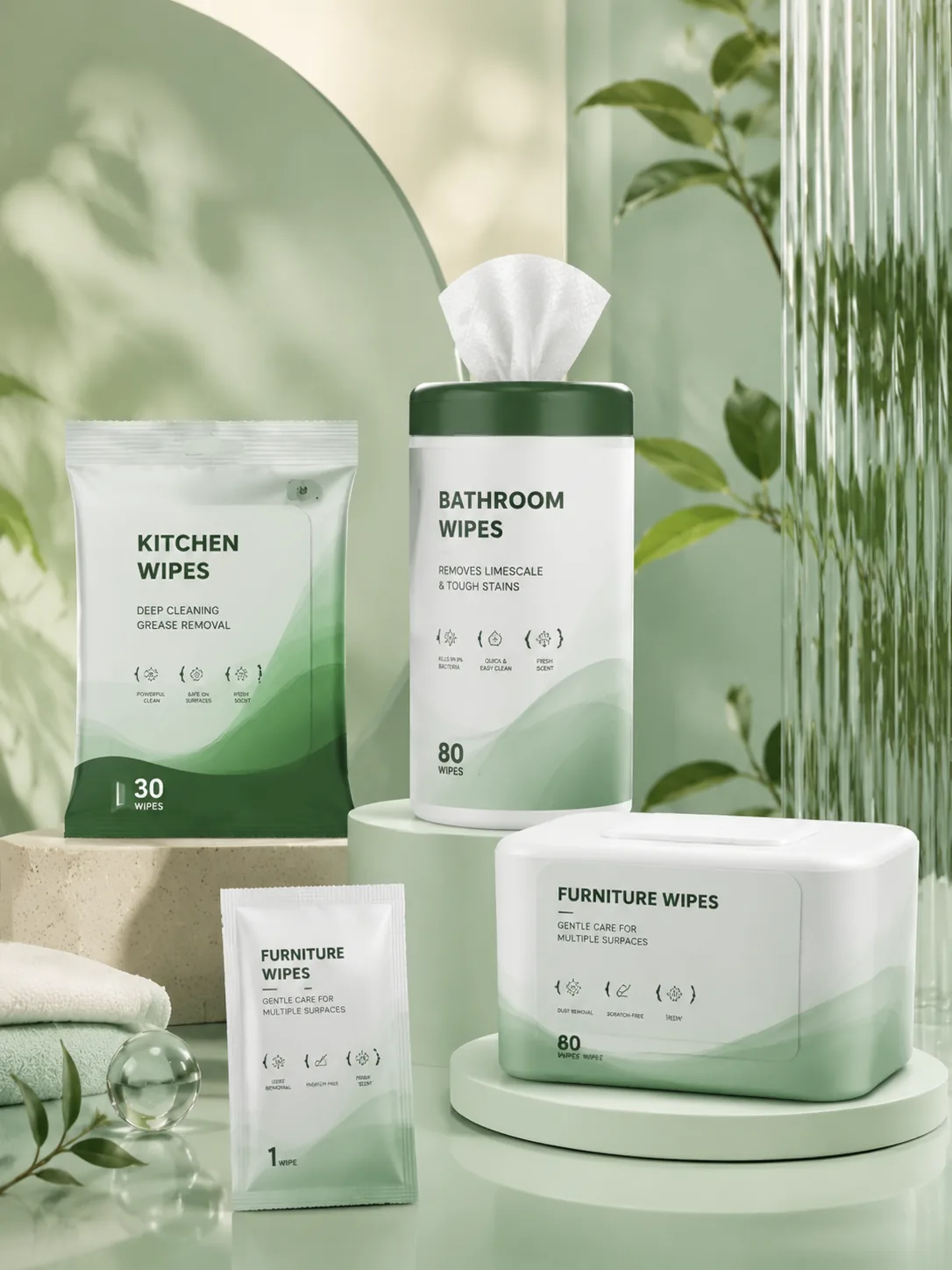
Two packs sit on the same shelf. One says 80 wipes. The other says 60.
The 60-wipe pack contains more non-woven than the 80-wipe pack. It also holds more liquid, weighs more, and costs more to make.
No trick. Just arithmetic, and it catches importers and distributors on their first wipes order.
Which pack are you actually paying for?
If you are a private label brand, importer, distributor or wholesaler sourcing household cleaning products from China, wipes reward a different set of questions than liquids do. The liquid is the easy part. The substrate, the sheet size and the pack format decide what you pay.
—
What Private Label Cleaning Wipes Cover in a B2B Range
A wipes range is not one product. It is four decisions stacked on each other, and each one moves the cost.
- The job. Degreasing, limescale removal, general surface, leather care, appliance care.
- The substrate. Spunlace non-woven, airlaid, carded. Different wet strength, different lint, different price.
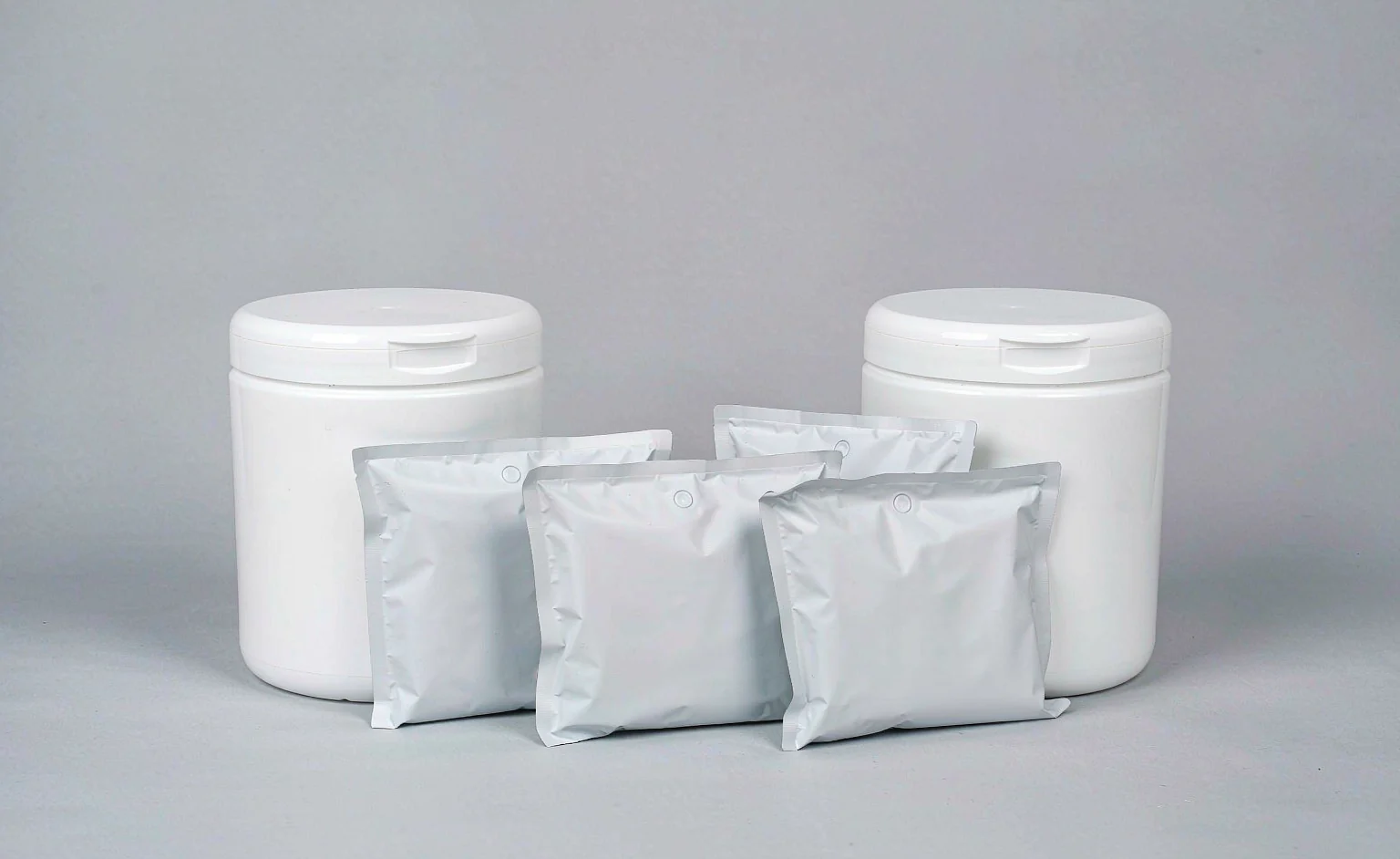
- The pack format. Canister or soft pack. Decided by the sales channel, not by preference.
- Sheet count and sheet size. The two numbers buyers compare, and the two that mislead most often.
A typical range settles into five jobs. A kitchen canister wipe for counters and sinks, and a degreasing soft pack for cooker hoods and hobs. A bathroom and toilet canister plus a limescale wipe for hard water. A dining table wipe for food areas, a leather wipe for upholstery, and an appliance wipe for drums and seals.
Most ranges stop at three to five of those. The sixth SKU usually exists because one retail account asked for it, and it is the one that never sells.
The practical takeaway: decide the job and the pack format before you ask for a quotation. A quote for “cleaning wipes” without a format is a range of prices with no basis for comparison.
—
Why 60 Cleaning Wipes Can Cost More Than 80
Sheet count is printed on the front of the pack in the largest type. Total material is what you pay for. They are not the same number.
Take two packs from a standard range:
| Pack | Sheets | Sheet size | Total non-woven area |
|---|---|---|---|
| Canister | 80 | 12 × 12 cm | 11,520 cm² |
| Soft pack | 60 | 16 × 14 cm | 13,440 cm² |
| Soft pack | 80 | 16 × 14 cm | 17,920 cm² |
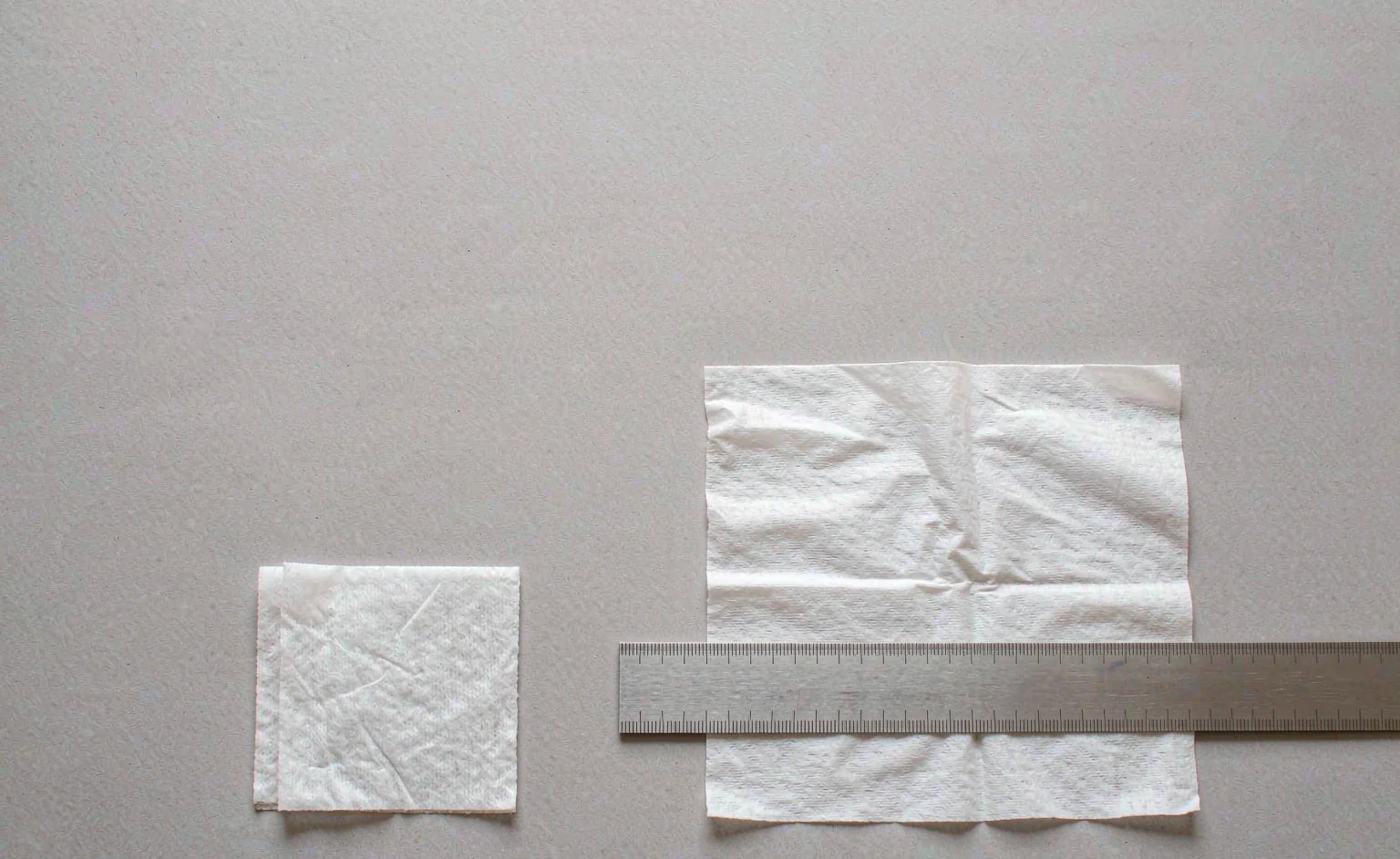
The 60-sheet soft pack carries 16.7% more non-woven than the 80-sheet canister. It has 25% fewer sheets and 16.7% more material.
Push the soft pack to 80 sheets and the gap becomes 55.6%.
Substrate is the largest cost line in a wet wipe after the liquid. The pack with the smaller number on the front is the more expensive one to produce, holds more liquid, and costs more to ship.
Three consequences land on the buyer:
- A supplier quoting per pack cannot be compared with one quoting per sheet. Convert both to total square centimeters first.
- A retailer asking for “80 sheets at the same price” is asking for 55.6% more substrate. The price will move. It has to.
- A soft pack at 60 sheets can legitimately cost more per pack than a canister at 80. That is not a negotiating position. It is the material bill.
The practical takeaway: build your comparison sheet around total non-woven area and total pack weight. Sheet count belongs on the packaging, not in the cost model.
—
Cleaning Wipes Sheet Size Is Set by the Pack, Not by Your Brief
Buyers arrive with a sheet size in mind. Usually 16 × 14 cm, because that is what a competitor uses.
Then they ask for it in a canister, and the quotation comes back at 12 × 12 cm.
This is not a supplier being difficult. A canister is a folded stack pulled upward through a lid, and the lid aperture sets the maximum sheet width. Push a 16 cm sheet through a 12 cm opening and it jams, tears at the fold, and pulls three wipes out at once. The consumer blames the brand, not the pack.
A soft pack has no fixed aperture. The stack sits flat in a flow-wrap and pulls sideways through a reclosure label, so a wider sheet is fine.
The two formats settle into two standard sizes, and almost every range converges on them:
- Canister: 80 sheets at 12 × 12 cm. Smaller sheet, more of them, pulled one at a time.
- Soft pack: 60 or 80 sheets at 16 × 14 cm. Larger sheet, fewer folds, flat stack. The bathroom soft pack and the dining table soft pack show the format in both jobs.
A non-standard combination is a tooling and folding question, not a pricing question. Ask early. It changes the fold pattern, the stack height and the carton.
The practical takeaway: specify the format first and let the sheet size follow. The reverse order produces a brief that cannot be built at the price you were quoted.
—
Spunlace Non-Woven: What a Cleaning Wipes Manufacturer Actually Makes
Here is the part that surprises buyers who have only sourced liquids.
A wipes factory does not make the wipe. It makes the pack.
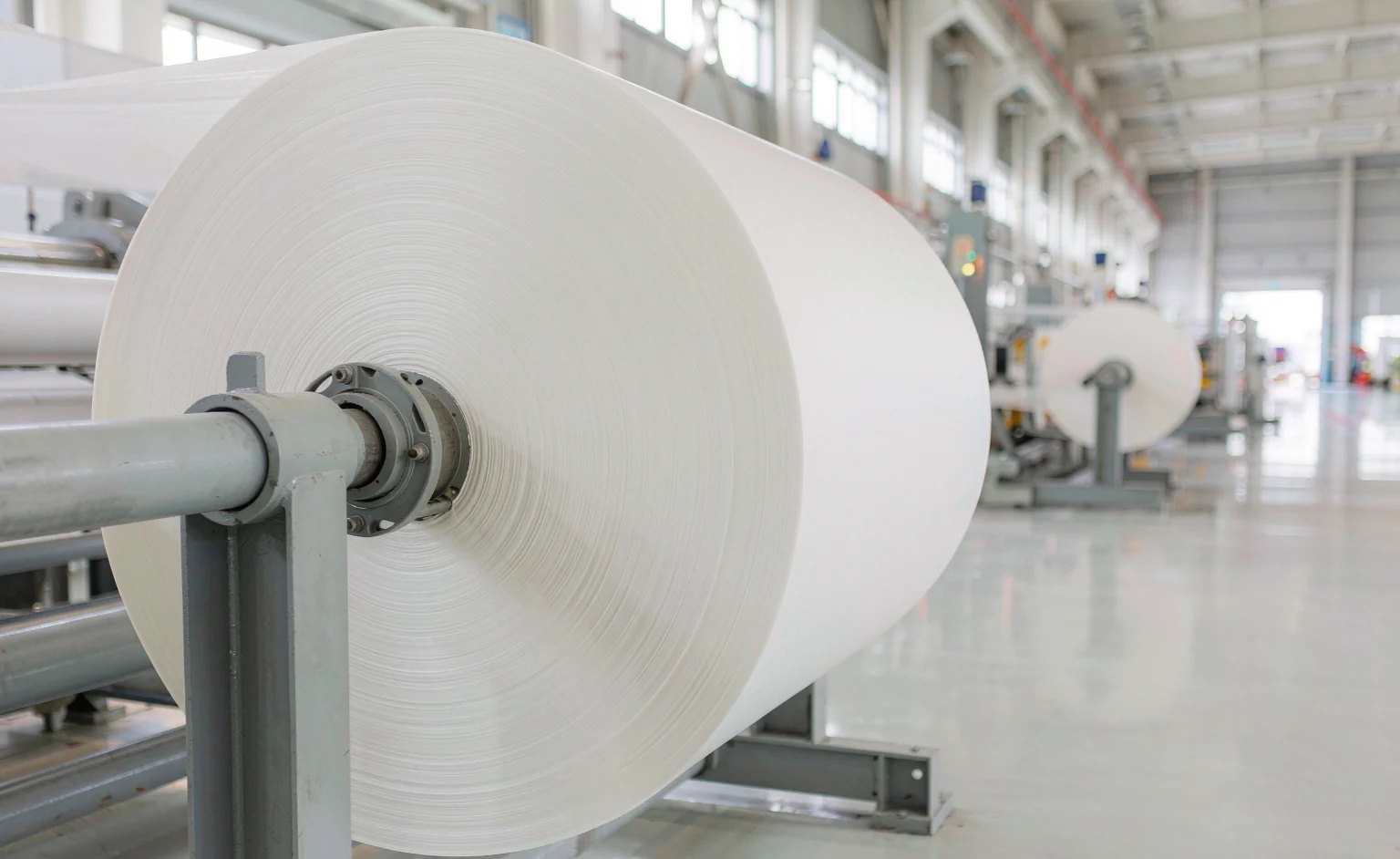
The non-woven substrate arrives on a roll from a specialist mill. Spunlace, also called hydroentangled, is the grade most household cleaning wipes use because it holds together when saturated, sheds little lint, and drapes without stiffness. Airlaid absorbs faster and tears more easily when wet. Carded is cheaper and coarser.
The converting line slits the roll, folds the web into a stack, saturates it with the cleaning liquid, fills the canister or seals the soft pack, applies the label and cases the cartons. Filling is the operation most suppliers own. The substrate usually is not.
That matters twice.
First, lead time runs on two clocks. The mill’s roll schedule and your filling slot are separate commitments, and a confirmed filling date is not a confirmed substrate date. For a first order, add two to three weeks to any quoted lead time on a wipes program.
Second, when you audit a supplier for an OEM or ODM wipes program, ask which of the four operations happen inside the building: substrate, converting, liquid filling, and carton. A supplier who converts and fills but buys substrate is a normal, credible wipes manufacturer. A supplier who claims all four is either very large or describing a trading relationship as a factory.
The practical takeaway: ask for the substrate mill and the grammage in writing. A quotation that names neither is a quotation for a pack, not for a wipe.
—
Cleaning Wipes pH Decides the Job and the Preservative
Every wet wipe is a water-based product sitting on a cellulose or polypropylene web inside a closed container. That is a growth medium. The preservative system is what stops it becoming one.
The pH you choose for performance sets the window your preservative has to work in. These two decisions are not independent, and treating them as independent is how a range ends up with a batch that fails at month eight.
The household range splits by pH for a reason:
- Slightly alkaline for kitchen grease. Baked-on fat needs alkalinity to saponify. Neutral does not touch it.
- Slightly acidic for limescale. Calcium and magnesium deposits dissolve in acid and shrug off alkali. A neutral wipe will smear hard-water marks around the tap.
- Neutral for general surface, bathroom fixtures and leather. Leather has no tolerance for either end of the scale.
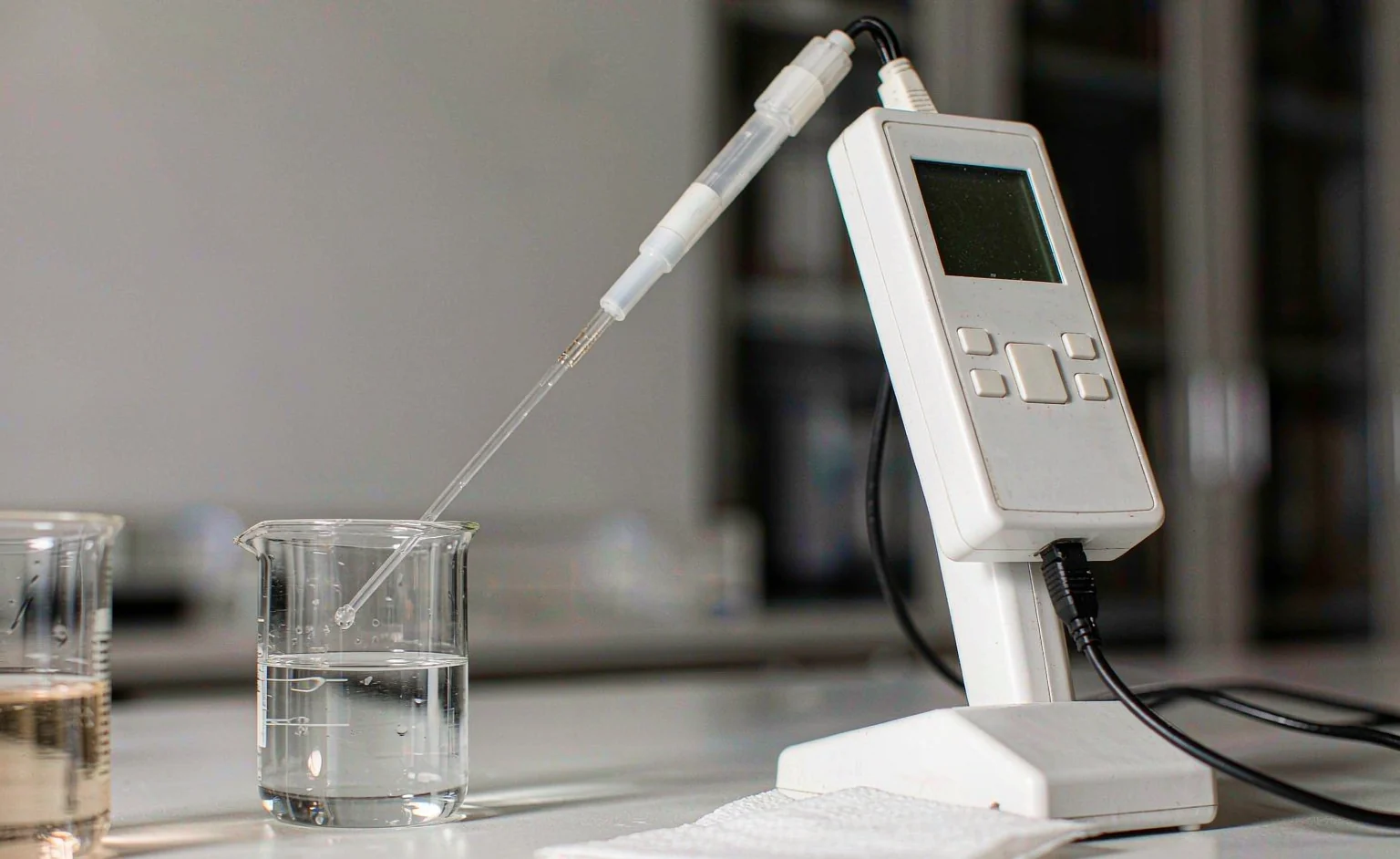
Now the trap. Many common preservative systems have a working range that stops well before the acidic end. Specify a low pH for limescale performance and you may have removed your own preservative from the formula. The wipe still cleans. It just does not stay clean inside the pack.
A second trap sits in the same place. A preservative that works at pH 3 may be incompatible with the surfactant you chose for degreasing. The formulation is a triangle, not a list.
The practical takeaway: ask what pH the product runs at and what preservative system holds it there, then ask for the challenge test result. A supplier who cannot produce a preservative efficacy report for the specific formula is asking you to take the risk.
—
Antibacterial Cleaning Wipes: A Regulatory Decision, Not a Marketing One
Sooner or later a retail buyer asks for “kills 99.9% of bacteria” on the label.
That sentence is not a copy change. In the European Union it moves the product into a different regulatory category.
Regulation (EU) No 528/2012, the Biocidal Products Regulation, covers both biocidal products and articles treated with them. Article 58 deals with treated articles. The practical effect: if an active substance is present in order to kill or inhibit organisms, that substance has to be approved for that use, and the article carries its own labelling obligations.
So the first question is not which active substance to use. It is whether the claim is one you can support with an authorisation and a test report.
Two habits keep this manageable:
- Treat every antimicrobial claim as a separate project with its own timeline, not as a line in a brief.
- Do not accept a claim you cannot document. A test report naming the organism, the method, the contact time and the dilution is the minimum. Anything vaguer is a liability that follows the brand, not the factory.
The same discipline applies to disinfecting wording outside the EU. The regime changes by market. The requirement to hold evidence does not.
The practical takeaway: if the claim matters to your positioning, budget for it as a compliance cost before you brief the artwork. If it does not matter, leave it off. An honest general-purpose wipe sells perfectly well without it.
—
Cleaning Wipes Format: Canister or Soft Pack by Sales Channel
The format is not a design preference. It is a channel decision, and it is usually made too late.
| Canister | Soft pack | |
|---|---|---|
| Shelf presence | Stands upright, stackable | Lies flat, needs a shelf strip |
| Perceived value | Higher | Lower |
| Plastic per pack | Higher | Lower |
| Shipping weight | Higher | Lower |
| Best channel | Supermarket, pharmacy, home retail | E-commerce, travel, convenience |
Three rules hold up in practice:
- Supermarket and pharmacy want the canister. It stands up, it stacks, and the lid reads as a reusable object rather than a disposable one.
- E-commerce wants the soft pack. Lower weight and lower plastic per unit both show up in landed cost, and a soft pack survives a parcel network better than a canister lid does.
- Travel and convenience want the soft pack at a small sheet count. 40 sheets is a real size here, not a rounding error.
The practical takeaway: name the channel before the format. A canister brief that ends up on an e-commerce listing is a freight bill you did not need to pay.
—
Why Household Wet Wipes Dry Out, and What 36 Months Means
A 36-month shelf life is a claim about the pack, not about the wipe.
The wipe itself is stable. The liquid does not evaporate through the substrate in any meaningful way. What fails is the reclosure.
- On a canister, the hinge on the lid is the weak point. A hinge that loses tension after 40 openings lets the top wipe dry into a disc.
- On a soft pack, the reclosure label is the weak point. Once the adhesive picks up lint or loses tack, the pack is open for the rest of its life.
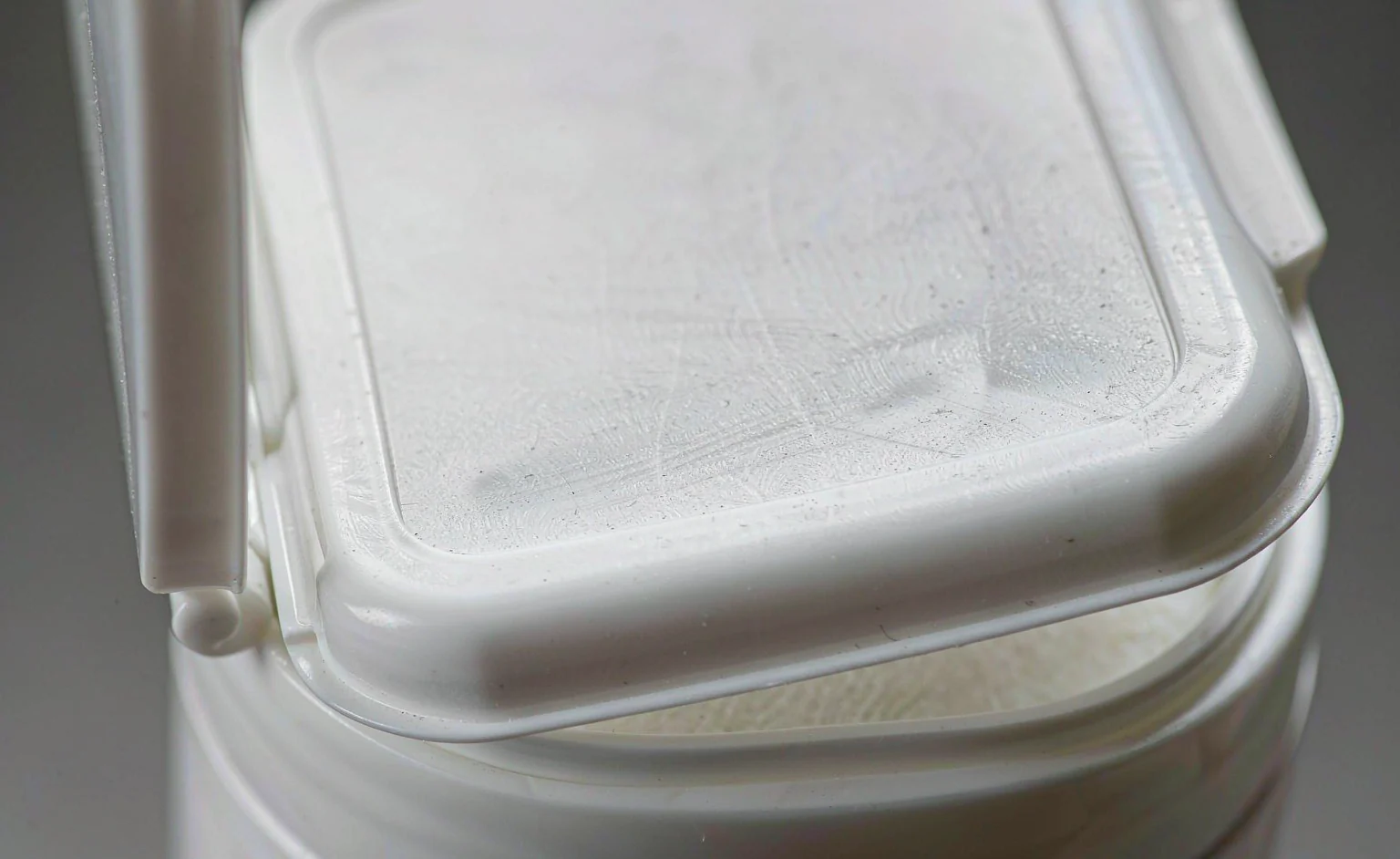
This is why a shelf-life claim is really a claim about the lid or film specification, and why a cheap lid is the most expensive component in the pack.
It is also testable, and almost nobody tests it. Open a pack, take out three wipes, close it, and leave it on a shelf for three weeks. Open it again. If the top wipe is dry or the stack has started to separate, the 36 months is a number on a document, not a property of the product.
The practical takeaway: approve the pack, not the sample. Ask for the lid or label specification and the closure test result alongside the wipe sample.
—
Household Cleaning Wipes and the PPWR Packaging Rules
Wipes sit in an awkward place under the EU packaging rules, because the canister is a plastic pack with a plastic label and a plastic lid, and all three have to work together at end of life.
Regulation (EU) 2025/40, the Packaging and Packaging Waste Regulation, has applied since 12 August 2026. Two dates matter most for a wipes range:
- 12 August 2028 — the harmonized material marking has to be on the pack.
- 1 January 2030 — recyclability performance grades start to bite, and plastic packaging outside the food-contact categories needs a minimum share of post-consumer recycled content.
For a canister, the practical exposure is the label. A PP body with a PET label is harder to recycle than a PP body with a PP label, and that is a choice you make once, at tooling. The lid is the second exposure, because a lid in a different polymer from the body creates the same problem.
Soft packs are simpler. A mono-material film with a compatible label is an easier conversation than a canister with three polymers in it.
The practical takeaway: choose the canister polymer and the label material in the same meeting. The pack you approve this year will still be in production in 2030.
—
Sheet Count, Carton and Container Loading for Wipes Importers
Wipes are a heavy, low-value-density product, and that shapes the freight more than most buyers expect.
The liquid is the majority of the pack weight. An 80-sheet canister is mostly water held in paper. So a container reaches its weight limit before it runs out of volume:
- Partial shipments and top-ups cost disproportionately, because you pay the fixed costs on a small volume.
- Air freight is not a recovery option. The economics do not work at any realistic rate.
- A carton that fits 12 canisters instead of 10 changes the container count by enough to move landed cost.
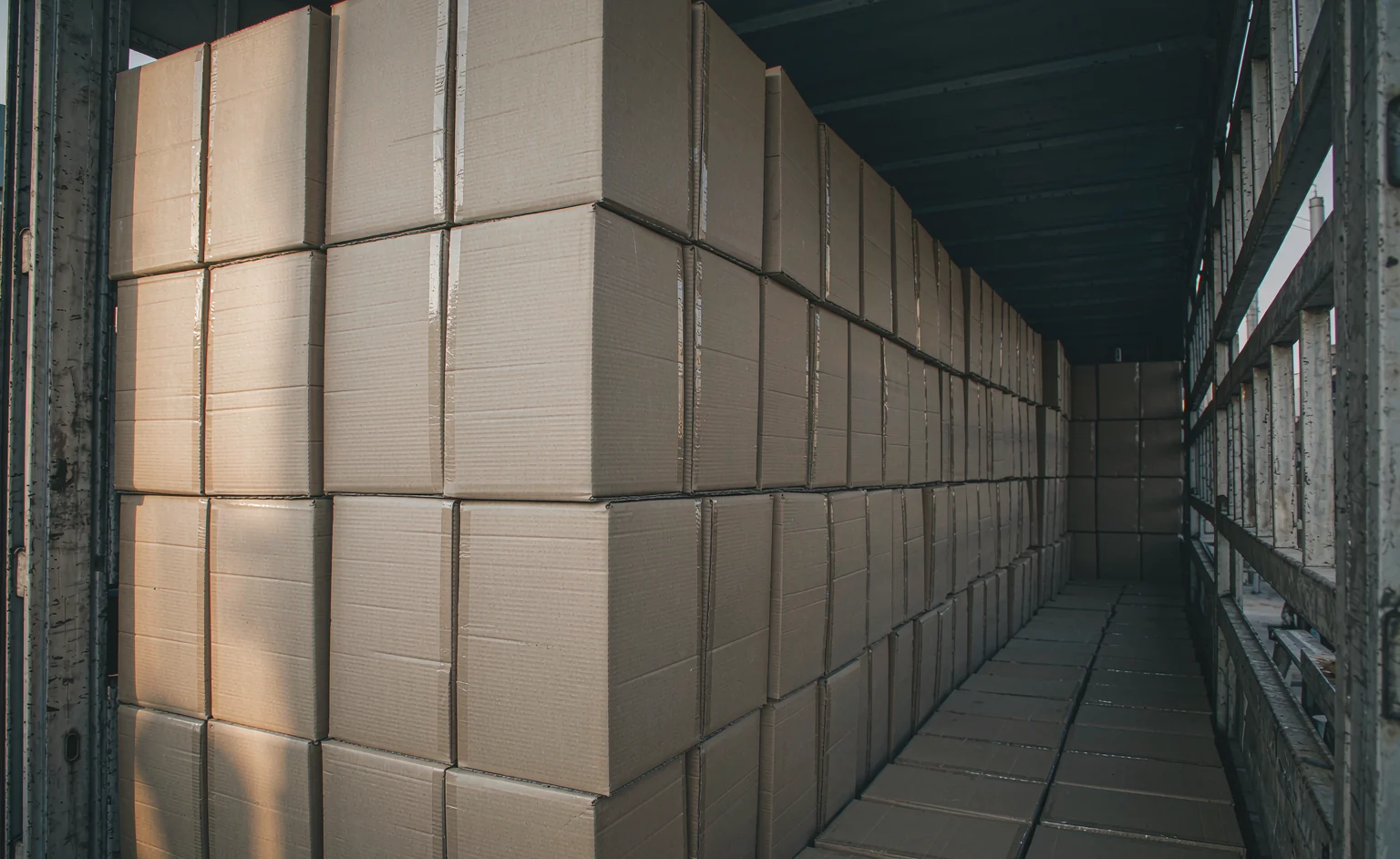
Ask for the carton dimensions, the units per carton and the cartons per pallet before you approve the price. A quotation without those three numbers cannot be converted into a landed cost, and the difference between two suppliers is often in the carton, not in the wipe.
The practical takeaway: model the order at container level, not at pack level. The freight line is where a cheap quotation stops being cheap.
—
How to Read a Cleaning Wipes Quotation
Most wipes quotations arrive with a model code, a sheet count and a price. That is not enough to compare two of them.
A complete specification for a private label cleaning wipes SKU has eight fields:
- Substrate type and grammage
- Sheet size in centimeters
- Sheet count per pack
- Liquid load, as a percentage of pack weight
- pH and preservative system
- Pack format, plus lid or label specification
- Units per carton, carton dimensions, cartons per pallet
- Shelf life, and what it was tested against
If two suppliers quote against the same eight fields, the comparison is real. If they quote against three, you are comparing a number to a number.
The practical takeaway: send the eight fields out with your enquiry. Suppliers who can fill all eight are the ones worth a sample request.
—
Cleaning Wipes: Common Questions
What is the minimum order quantity for private label cleaning wipes?
It depends on the pack format more than the sheet count. A canister needs a lid and a label, both carrying setup costs, so the canister minimum usually sits above the soft pack minimum for the same wipe. Ask for the MOQ per format, not per range.
Can you match a cleaning wipe we already sell?
Usually for the substrate and the pack, conditionally for the liquid. Matching a formula means matching the pH, the surfactant system and the preservative together, and the preservative has to be tested rather than copied. Send a sample and the current specification.
Which sheet size should we choose?
Let the format decide. A canister settles at 12 × 12 cm because the lid aperture sets the limit. A soft pack settles at 16 × 14 cm because a flat stack has no such limit. Choosing a size first produces a brief that cannot be built at the quoted price.
Can you supply the canister and the lid as well as the wipe?
Ask which components are made in the plant and which are bought in, and get the lead time of each bought-in part in writing. For wipes, the substrate roll and the lid are usually the two external items, and either one can move your ship date.
Do you supply the documentation needed for EU packaging compliance?
Ask for the polymer and material composition of the canister, lid and label, and for the recycled content figure where it applies. Those are the inputs a brand needs for the material marking and the recyclability assessment.
—
Working With a Cleaning Wipes Manufacturer
We manufacture household cleaning wipes in Zhongshan, in southern China. The household cleaning wipes range covers kitchen, bathroom, dining and furniture care in both canister and soft pack formats. Converting and filling run in the same plant, and the bottle blowing and injection molding for our liquid lines run in the same building, which is why a mixed wipes and liquid order can leave on one schedule.
Converting is only half of a wipes manufacturing program. The substrate comes from dedicated non-woven mills, and the lids and labels come from dedicated suppliers. We say that plainly because it is the part of the chain that decides your delivery date, and a buyer who knows it asks better questions.
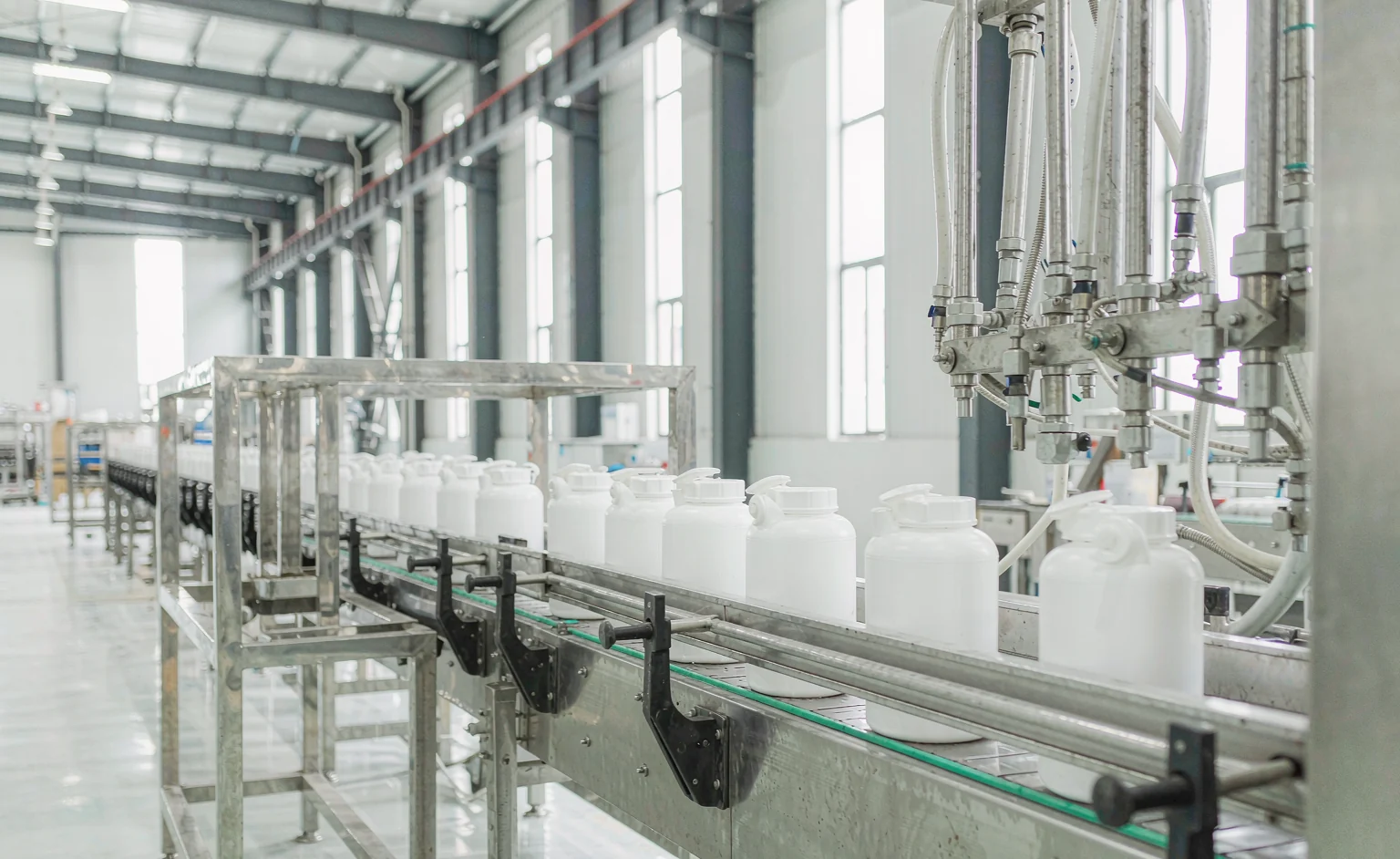
What our OEM and ODM programs cover:
- Matching an existing pack, or building a format around your channel
- Adjusting pH and fragrance to your market, with the preservative system tested against the final formula
- Supplying canister and soft pack in the same SKU family, so one artwork system covers both
What we will tell you honestly: if your brief needs an antimicrobial claim, that is a compliance project with its own timeline, and it should not be attached to a first order. Get the pack right first.
Have a product idea for your market?
Talk to our team about your next household cleaning project.
BIKI Home Care
37 Chigang Road, Xiaolan Town, Zhongshan City, Guangdong Province, China
—
Sources
European Union, Regulation (EU) No 528/2012 concerning the making available on the market and use of biocidal products. The Biocidal Products Regulation; Article 58 sets the obligations for treated articles, including the requirement that an active substance used to protect an article be approved for that use.
European Union, Regulation (EU) 2025/40 on packaging and packaging waste. The PPWR; applies from 12 August 2026, with the harmonized material marking from 12 August 2028 and recyclability performance grades and recycled content requirements from 1 January 2030.
European Chemicals Agency, Biocidal Products Regulation, treated articles. Guidance on when an article falls under Article 58 and what labelling and information obligations follow.
BIKI Home Care, household cleaning wipes range. Canister and soft pack specifications, sheet sizes and pack formats referenced in this article.
BIKI Home Care, PPWR packaging compliance for cleaning products. The 2028 and 2030 dates applied to a typical cleaning product pack.
BIKI Home Care, household cleaning product packaging costs. Why the pack, not the liquid, decides the landed cost of a cleaning product order.